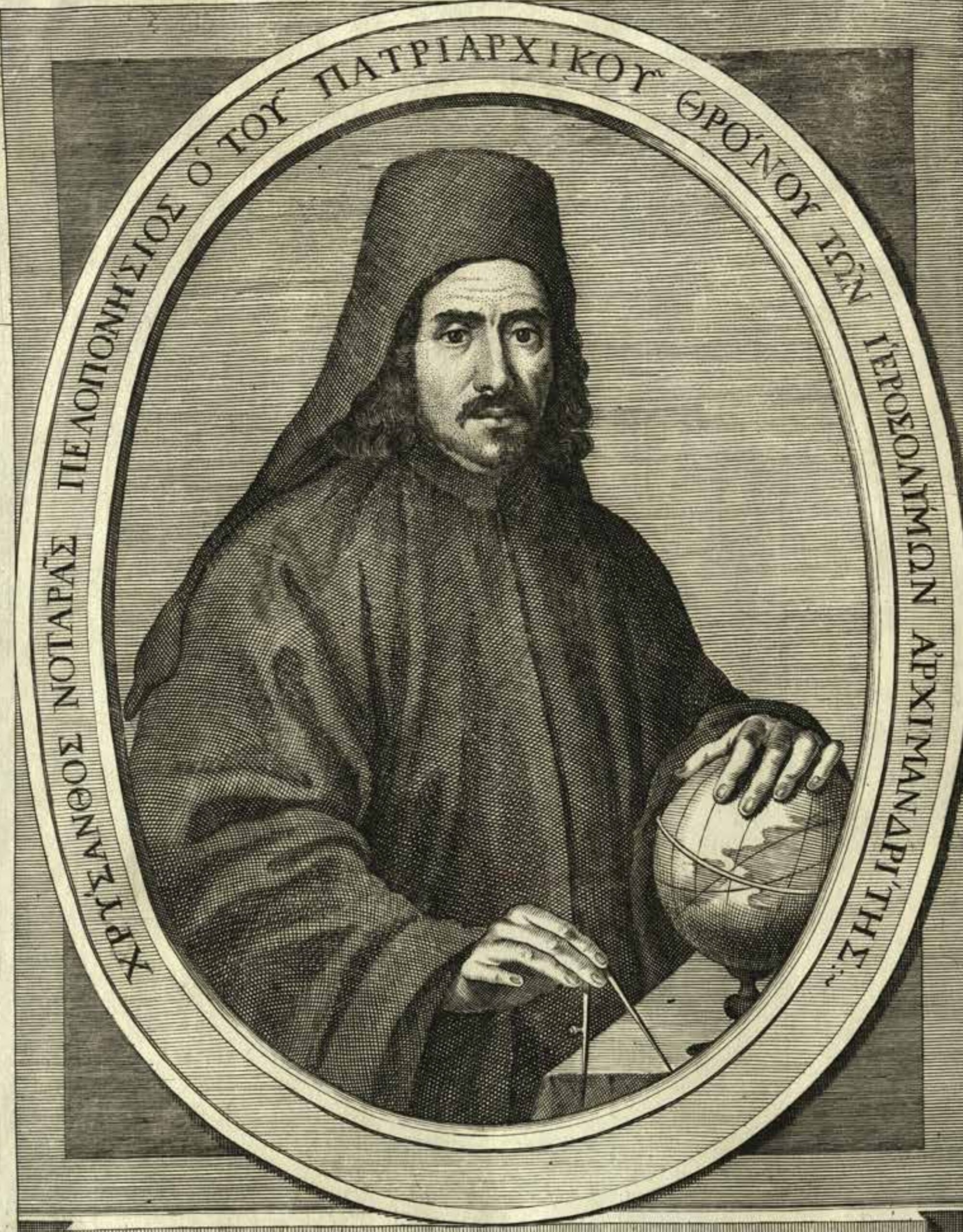
Kinsman and successor of Dositheus Notaras, the patriarch of Jerusalem Chrysanthus Notaras (1707-1731) was one of the most erudite Greeks of his time. Educated in Padua and Paris, he wrote works of theology, history, geography and the natural sciences, traveled as far afield as Moscow and Georgia, and maintained correspondences with both Western and Ottoman scholars (the latter, in Turkish). In his Syntagmation, published in Wallachia in 1715, he gives an organizational and geographical description of the entire Orthodox world of his time, enumerating the dioceses and structures of the Patriarchates of Constantinople, Alexandria, Antioch, Jerusalem and Moscow, as well as the autocephalous churches of Ochrid, Cyprus, Peć, and Upper and Lower Georgia.
In his description of the Patriarchate of Antioch, translated below (Greek original available here, French translation here), Chrysanthus is acutely aware of the cultural differences between Antioch and the other ancient patriarchates, especially noting the relatively egalitarian relationship between its bishops, which he attributes to their Arab culture. Nevertheless, although he notes that the Antiochian bishops themselves do not use such terms, he attempts, rather unsuccessfully, to shoehorn the titles of the Antiochian dioceses into the ancient Roman civil system. The neutral tone in which Chrysanthus describes the near-total absence of Greek in Syria and the Arab identity of the local Orthodox Christians demonstrates that prior to the xenocracy of the late 18th and 19th centuries, questions of cultural identity were not often cause for controversy or rivalry in Antioch. This is consistent with the self-identification of the Antiochian Orthodox in the early 18th century, as can be seen in the verse eulogy at the beginning of the Arabic volume of the Gospels printed by Athanasius III Dabbas in Aleppo in 1708, sponsored by the Cossack hetman Ivan Mazepa, in which the Antiochian Orthodox repeatedly describe themselves as “Arabs” and their country as “the Arab lands.”
On the Most Holy Patriarchal See of Antioch
1) With regard to this most holy and apostolic patriarchal see, it must be mentioned that on account of the savageness of the infidels (ἐθνικῶν) and the great rudeness (ἀπήνειαν) of the infidels living in the city of Antioch, its current most holy patriarch cannot live there, but rather [lives] in Damascus, which is now called Sham, because more Christians and wealthy families reside there and the infidels there are more civilized. He visits there just as he visits the other eparchies of the see that will be mentioned and remains there for as many days as is necessary or he wishes.
2) The extant metropolitan sees depending on the see [of Antioch] do not have a fixed taxis, such that one could know which is first, second, third, etc., but rather they are mixed together, so when the holders [of the sees] come together, either with their patriarch or without him, they choose among themselves and the most noteworthy and respectable among them have precedence.
3) We will indicate the eparchies that are certainly under the [see] of Antioch at the time when, on the way to holy Jerusalem, we stayed with our blessed brother and concelebrant, the holy [patriarch] of Antioch kyr Cyril in Damascus and asked to know precisely which metropolitan sees are now under His Beatitude. He indicated to us those that will soon be enumerated, which are listed in Greek (Ῥωμαϊκὰ) and Arabic at the end of an Arabic book belonging to His Beatitude, which was copied well by a careful person.
4) The See of Antioch does not have bishops, but only metropolitans, and each metropolitan has within his diocese other metropolitan sees and bishoprics that existed in ancient times and are reduced to a single eparchy.
5) Damascus is rightly a metropolitan see and it does not have greater dignity because of the fact that the patriarch now resides there.
6) According to Arab custom, titles such as “most honorable” or “exarch” are not used, but rather the hierarchs address each other as “brothers.”
7) Throughout the Patriarchate of Antioch, the Christians, both clergy and laity, use the Arabic language, apart from a few areas where Greek (γραικικὰ) is used, such as Alexandria on the Issus, which depends on the metropolis of Adana and which the infidels call “Scanderoon” and the Italians “Alessandretta.” According to some, it is in Cilicia, and according to others, it is in Syria, since it is on the border between those two eparchies. [Greek is also used] in a few villages around Adana. They are foreigners from Cyprus. It is the same in Erzurum, and there are also [Greek-speaking] merchants in various places on account of their business.
8) Phoenice is divided in two. To distinguish it, one is called simply Phoenice, Phoenice Paralia, or Phoenice Prima, while the other is called Phoenice Libanensis.
9) According to the ecclesiastical system of eparchies and the ancient ordinance of the emperors, Damascus is placed in Phoenice Libanensis, but according to some geographers and historians, it is in Coele-Syria. For this reason, the metropolitan of Damascus is called most honorable, exarch of Phoenice Paralia or Coele-Syria.
The metropolitan sees under the Patriarch of Antioch:
Of Berroea in Syria (which is now commonly called Aleppo), most honorable, exarch of Syria Prima, locum tenens[1] of Hierapolis on the Euphrates [i.e., Manbij]. It should be known that Berroea is written both with one ‘r’ and with two, while some people write Berroea in Macedonia with two rr’s to distinguish them from each other.
Of Epiphaneia, most honorable, exarch of Syria Secunda, locum tenens of Apamea. It should be known that the Latins’ geographical dictionaries call the latter city ‘Hama’, however this is not correct, since we inquired precisely when we were going to the holy city of Jerusalem. Rather, [Hama] is Epiphaneia and Apamea is now called in the local Arabic language ‘Median’. We also realized this from many other indications, and this is clear from Strabo (book XVI), who recounts the following about Apamea: it is surrounded by large and high walls, at the feet of which are many very good and pure flowing springs, full of fish, before entering it there is a vast and pleasant plain, etc. All of this, as well as what we mentioned in our Itinerary to Jerusalem can still be found today in Median and not at Hama, where there is nothing like that.
Of Laodicea [i.e., Lattakia], most honorable, exarch of Theodorias.
Of Seleucia, most honorable, exarch of Syria Prima. Seleucia is now called Maaloula.
Of Amida [i.e., Diyarbakir], most honorable, exarch of all Mesopotamia and Armenia Quarta, locum tenens of Edessa.
Of Tyre and Sidon, most honorable, exarch of Phoenice Paralia. In Arabic Tyre is now called Sur and Sidon, Saida.
Of Tripoli, most honorable, exarch of Phoenice Paralia or Phoenice Prima. In Arabic, Tripoli is called Sham Trablusi [Σὰμ Τραπλουσὴ, evidently meaning Tarabulus al-Sham] or Tarabulus.
Of Bostra (now called Hawran), very honorable and exarch of Arabia Petraea.
Of Emesa, most honorable and exarch of Phoenice Libanensis. Emesa is now called Homs.
Of Beirut, most honorable and exarch of Phoenice Paralia.
Of Adana (which is now called Bayas), most honorable, exarch of Cilicia Prima and Secunda, and locum tenens of Seleucia and Isauria.
Of Heliopolis, most honorable, exarch of Phoenice Libanensis. Heliopolis is now called Baalbek.
Of Arka [i.e., Akkar], most honorable, exarch of Mount Lebanon, locum tenens of Acre. Acre is now called Ptolemais.[2]
Of Palmyra, most honorable, exarch of Phoenice Libanensis. It is also named Adrianopolis, since it was founded by the Emperor Hadrian, according to Stephanus in his book on cities. Thus, in some taktika, it says Adrianopolis instead of Palmyra.
Of Seidnaya, most honorable. We have not found it in the ancient books, but it is located in Phoenice Libanensis. The eponymous Monastery of Seidnaya, dedicated to the most holy Theotokos, is there, situated on a hilltop and inhabited by Arab nuns. It is said to be a foundation of Justinian the Great and because of this and especially because of the constant miracles and healings that take place there, it is honored throughout Arabia. It abounds in various votive offerings. We ourselves, on our way from the holy city of Jerusalem to Constantinople and afflicted by a contagious illness on the way, were hosted there for sixteen days and we donated to Our Lady there a golden enkolpion with jewels and pearls, and we also sent a silver candlestand from Constantinople.
Of Theodosiopolis (now Erzurum), most honorable and exarch of all Armenia Maior.
Of Akiska [i.e., Akhaltsikhe], most honorable.
Notes
[1] Chrysanthus uses the term ‘locum tenens’ (τόπον ἐπέχον) to indicate that a former episcopal see is found within the metropolitan’s current diocese.
[2] It is quite strange that the patriarch of Jerusalem confuses Akkar, in the north of today’s Lebanon, with Acre (Ptolemais) in Palestine. As part of Phoenice Prima, Acre was definitively assigned to the Patriarchate of Antioch at Session VIII (in the Latin version, Session VII) of the Council of Chalcedon. It only came under the Patriarchate of Jerusalem during the 17th century, under very unclear political and canonical circumstances. In any case, Chrysanthus also lists Ptolemais as one of the eparchies of the Patriarchate of Jerusalem at the bottom of the same page.


Leave a Reply