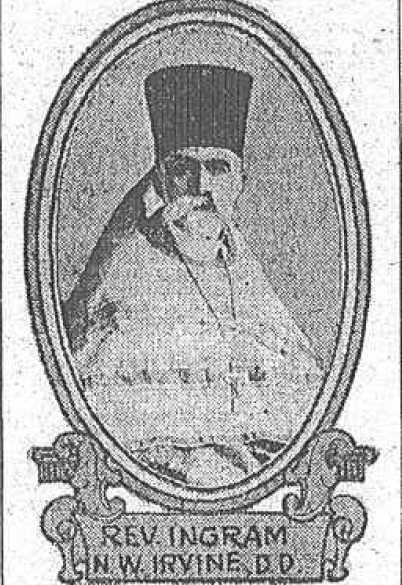
I’ve written more words about Fr. Ingram Nathaniel Irvine than about any other historical figure. Irvine was an Episcopal priest who converted to Orthodoxy in 1905, was ordained by St. Tikhon, and played a major role in American Orthodoxy until his death in January 1921. He was a trusted assistant to St. Raphael Hawaweeny, and he was the chief advocate of the use of English in Orthodox worship. Irvine’s significance to American Orthodox history is difficult to overstate.
I’m now working on a book about Irvine. No specifics yet, but I plan to finish it by the time I graduate from law school in a year. I’ve slowly begun to review my sources on Irvine, and I stumbled onto a really, really strange bit of information.
Irvine died in Brooklyn on January 23, 1921. The first obituary was published the next day, in the Brooklyn Daily Eagle. This obituary seems to have been the main source for the obituaries that appeared in numerous other papers in the following days. Here’s the weird part:
The Rev. Dr. Ingram N.W. Irvine, 71 years old, in charge of the English division of the Eastern Holy Orthodox Catholic Church of America, died on Sunday, of heart trouble, at his residence, 677 Sterling pl. The funeral services will be held tomorrow morning at 11 o’clock, at Dr. Irvine’s late home, the Rev. A.L. Charles, rector of St. Mark’s P.E. Church, officiating, and the internment will follow in Greenwood Cemetery. Dr. Irvine is survived by his wife, Mrs. Emmalena Wilson Irvine, and a daughter, Mrs. Annie Chapin.
There’s not really any question that Irvine remained Orthodox to the end of his life. Even this obituary speaks of him as being the head of the “English division” up to his death. And if you know anything about Irvine, you know that he was a stubborn mule who wouldn’t just cut and run from a church at the first hint of discomfort. I’m 99.9% certain that Irvine did not revert to Episcopalianism in the month before he died.
So why was Irvine’s funeral in his home and not in a church — and why did an Episcopal priest officiate? Apart from the almost impossible prospect of a deathbed apostasy, here are the most likely scenarios I can come up with (with help from Aram Sarkisian and Fr. Oliver Herbel):
1. Irvine’s widow and/or daughter arranged for an Episcopalian funeral. This, in my view, is the most likely scenario. We don’t know much of anything about Emmalena, Irvine’s wife. Yes, she helped Irvine with his teaching ministry, but we don’t even know if she formally converted to Orthodoxy. For all we know, she remained Episcopalian even after her husband’s conversion. As for daughter Annie, she was a very dysfunctional person. It’s a story for another day, but suffice it to say that Annie stole from a lot of people, probably was a con artist, and left her children to be primarily raised by their grandparents (the Irvines). I doubt she’d demand an Episcopalian funeral, but her motives are difficult to follow. In any case, Emmalena and/or Annie may have asked Rev. A.L. Charles of St. Mark’s Episcopal Church to officiate.
2. Irvine himself asked for an Episcopalian funeral, but remained Orthodox. This is less crazy than it sounds. According to Aram Sarkisian’s research, Irvine’s bishop, Abp Alexander Nemolovsky, was in Canada when Irvine died. And Irvine had just been through a bad experience with a failed convert parish led by the erratic Archimandrite Patrick Mythen (who, incidentally, was probably in Canada with Abp Alexander when Irvine died). The nearest Orthodox bishop was the Syrian Bishop Aftimios Ofiesh of Brooklyn — a man Irvine hated. Irvine may have been so upset with the nearby Orthodox authorities that he preferred to be buried in a quiet ceremony officiated (perhaps) by an Episcopal priest that Irvine respected.
3. Irvine had an Orthodox funeral and an Episcopalian memorial service. This theory, suggested by Fr. Oliver, assumes that the newspapers just didn’t know about the Orthodox service. Along similar lines, Fr. Oliver points out that the Orthodox and Episcopalians may have officiated at the same funeral service. After all, in that era, it wasn’t unheard of for Orthodox and Episcopalian priests to officiate at the same marriage ceremony. I find this suggestion somewhat less likely than the possibility of dual funerals, simply because the Episcopalian funeral reported in the Eagle took place at Irvine’s home, rather than a church. Which suggests that it was something less than an “official” event. If Orthodox clergy were involved, why not do it at a church?
Anyway, at this point, we don’t know what was going on with Irvine’s funeral. But the three of us — Fr. Oliver, Aram, and I — are trying to track down what happened.
This article was written by Matthew Namee.


Leave a Reply