On June 8, the OCA website published “A Letter of a Parish Priest to His Flock.” This letter has been shared widely on social media, by people of many different Orthodox jurisdictions. It was written by an unnamed OCA priest in the Diocese of the South and was made public by his bishop, Archbishop Alexander of Dallas. Certain aspects of this letter touch on historical matters, and it is on these things that I’d like to focus.
***
The unnamed priest writes, “Many people, particularly online, are now in a huff about practices concerning cleaning or even replacing the spoon. The use of a spoon for Holy Communion is approximately 1000 years old. That means, prior to that, there was no Communion spoon. I will not take time to go into the more ancient practices for receiving Holy Communion, I will only say that to make a dogma out of the spoon is wrong.”
What were the “more ancient practices” that the priest does not discuss? From the time of the Apostles, all of the faithful received Communion in the way that the priests and deacons still do to this day: they received the Body in their hands, and then they sipped the Blood from the chalice — a common chalice. The spoon appears to have supplanted the older method for purely practical reasons — it’s much less messy to feed the faithful by the spoon than it is to put the Body in their hands, which risks the dropping of crumbs, etc. It also happens to be quicker when you’re communing a large number of communicants at a single Divine Liturgy. In any event, the older method is certainly not “more sanitary” than the spoon, from a secular perspective, as it involves the faithful sucking up bread crumbs from their hands and drinking from a shared cup.
***
The priest then turns to the Old Believer schism:
Brothers and sisters, there is real danger of another sort of Old Believer schism affecting the Church today as it did in Russia a few hundred years ago when people refused to accept changes to the service books and some of the practices of the faithful even when it became clear that the old ways were mistaken. At that time the corrections were often introduced heavy-handedly, but that is not the case in our situation, where the bishops have considerately and in the face of a serious health crisis introduced temporary changes, changes which in no way affect the dogmas or teachings of our Faith.
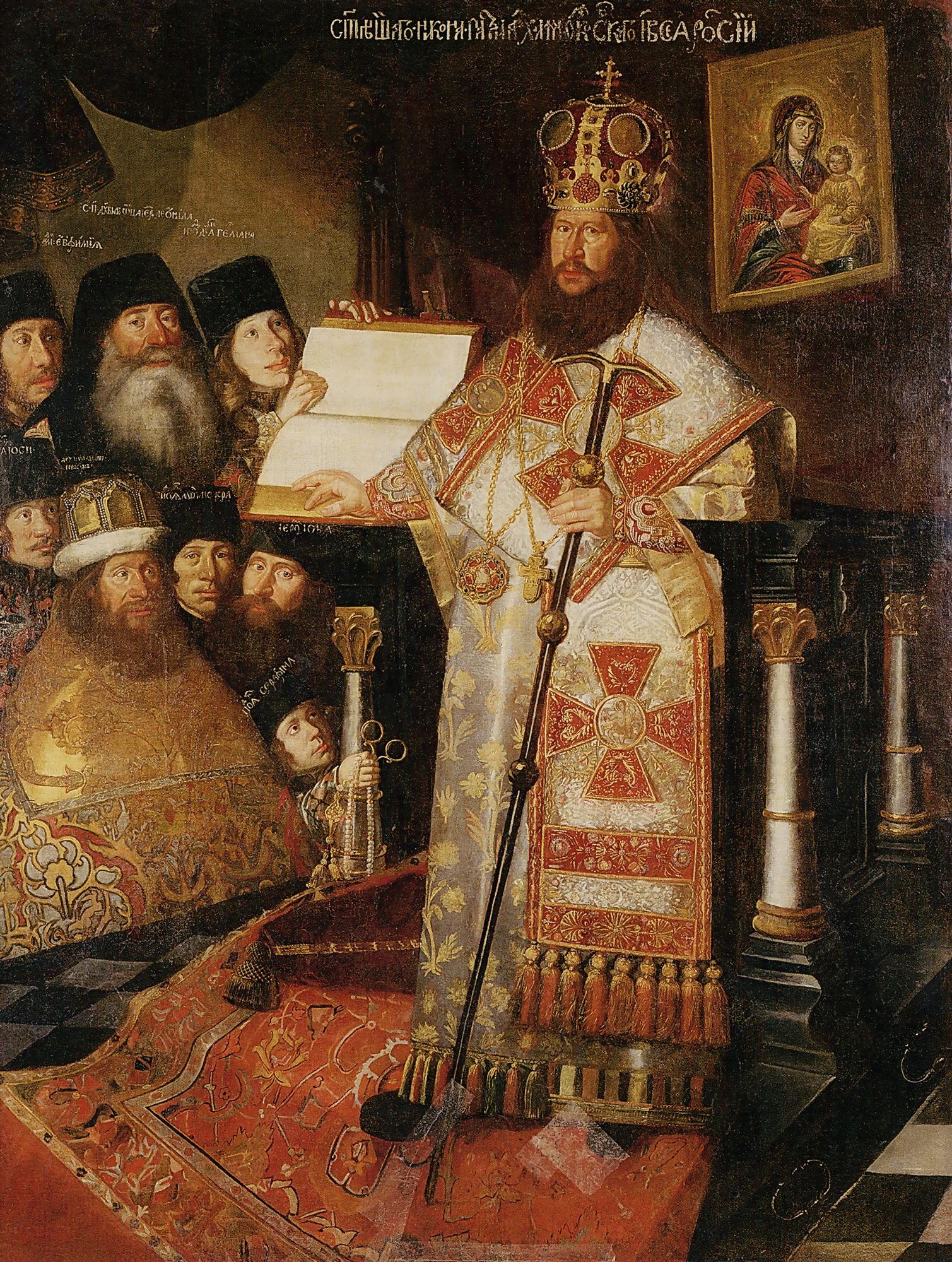
In 1652, Patriarch Nikon ascended to the throne of the Moscow Patriarchate. As Metropolitan Kallistos Ware writes in The Orthodox Church, “Nikon was probably the most brilliant and gifted man ever to become head of the Russian Church; but he suffered from an overbearing an authoritarian temper.” Nikon discovered a number of differences between the practices of the Russian and Greek Churches, and he decided to “correct” these Russian practices by ordering immediate, unilateral changes applicable throughout the entire Moscow Patriarchate. The most famous of these changes involved the Sign of the Cross — the Russians had been making it with two fingers, and Nikon insisted that they must now make it with three, like the Greeks.
A significant minority in the Russian Church rejected Nikon’s reforms. In a 1957 paper, Serge Zenkovsky explains, “What were the real causes of this contention over the reforms? The Patriarch and the Tsar wanted to remove the discrepancies which had crept in over the centuries; they wanted to introduce a common Orthodox ritual. Opponents of reform regarded the Muscovite practices as an inseparable part of the Russian Orthodox way of life — as, indeed, sanctified by generations of Muscovite clerics, saints, and laymen.”
This was a sensitive pastoral situation, and Patriarch Nikon was not up to the challenge. Metropolitan Kallistos writes, “Had Nikon proceeded gently and tactfully, all might yet have been well, but unfortunately he was not a tactful man.” Opponents of Nikon’s reforms — “Old Believers” — were harshly persecuted. In 1666-67, a Pan-Orthodox Council was held in Moscow, presided over by the Patriarchs of Alexandria and Antioch. The Council’s decision was nuanced. Metropolitan Kallistos summarizes it in this way: “The council decided in favour of Nikon’s reforms, but against his person: Nikon’s changes in the service books and above all his ruling on the sign of the Cross were confirmed, but Nikon himself was deposed and exiled, a new Patriarch being appointed in his place.”
Unfortunately, the schism was not healed — it has persisted to the present day, although in recent times some Old Believers have reunited with the Russian Orthodox Church.
***
So what does the Old Believer schism have to tell us about the present controversy over the Communion spoon?
Firstly, it’s important to note a significant difference between Nikon’s reforms and the spoon issue: In the case of Nikon’s reforms, there was broad consensus among the Orthodox hierarchy. This is not the case with the spoon. The majority of the Orthodox Churches are not changing the traditional practice. The Moscow Patriarchate has introduced a temporary measure to “disinfect” the spoon between communicants, and outside of that, a relative handful of bishops in the so-called “diaspora” have mandated some version of multiple spoons. Everyone else is sticking with the common spoon.
This is in stark contrast with the Nikonian reforms, in which Nikon attempted to align the Russian Church with the practices of the other Orthodox Churches. A comparable approach today would be for the “multiple spoons” bishops to switch back to the common spoon — not the other way around. Instead of Nikon’s reforms, the current changes are perhaps more akin to the “Living Church” in 1920s Communist Russia, when changes in the external conditions of society created momentum for advocates of change within the Russian Church. In addition to the headline revisions of the Living Church, such as allowing clergy (including bishops) to marry after ordination and retain their ranks, those renovationists made liturgical changes, including moving the altar to the center of the church.
The Old Believers were primarily laypeople who rebelled against a united Russian Church hierarchy. American Orthodoxy, with its tangle of jurisdictions, is nothing like this. The American Orthodox laypeople who are currently questioning their bishops live side by side among other Orthodox faithful whose bishops are not innovating.
Furthermore, the unnamed priest insists that, unlike Nikon’s “heavy-handed” approach, the OCA bishops (the subject of the author’s letter) have introduced their changes “considerately.” This, of course, is a matter of opinion, but any mandate handed down from above, without exceptions and without the hard work of consensus-building, runs the risk of being “heavy-handed” and creating unintended divisions.
I am sure that the bishops who are introducing liturgical changes today are all gentle and loving men, acting in what they believe to be the best interests of their flocks. I’m not saying this in a pandering way — I mean it. Precisely because of this, it is important that they consider the Nikonian reforms as a warning, not only to their frustrated parishioners (i.e., don’t be like the Old Believers), but to themselves (i.e., don’t be like Nikon). Nikon may have been right, but his pastoral approach was wrong, and had disastrous consequences.
***
Finally, the unnamed priest assures us that the spoon issue is not dogmatic. And to be sure, there is nothing inherently “dogmatic” about the use of a spoon — after all, it wasn’t used for the first thousand or so years of church history. But the underlying issues most certainly are dogmatic: What is Communion? Can it be a vector for disease? If I become sick after taking Communion, what does it mean? The answers to these questions have significant dogmatic and soteriological implications.
The priest says that many people “are now in a huff” about the spoon issue and he decries “‘Armchair bishops’ without the grace of the episcopacy.” From the context, it seems that the priest is focusing his criticisms on people who pontificate on the Internet. Fair enough. But many faithful Orthodox clergy and laity are genuinely concerned about the changes being mandated by certain hierarchs, and the correct response to those concerned people is not the stereotypical counsel to “pray, pay, and obey” that seems to underlie this anonymous letter. There are real dogmatic issues here, and they concern the entire Body of the faithful.
It seems to me, then, that both the frustrated clergy and laity and the innovating hierarchs should take heed: we the faithful should not become like the Old Believers, but likewise the hierarchs should strive not to imitate Patriarch Nikon.


Leave a Reply