NOTE: I have continually updated this article as I have received more information or had new thoughts occur to me.
For Orthodox Christians, what do California, Illinois, Indiana, Iowa, Kentucky, Louisiana, New York, Ohio, Pennsylvania, and Washington DC have in common? They all have major relics of Orthodox saints that American Orthodox Christians largely don’t seem to know about.
There are currently seven major shrines of the full relics of canonized Orthodox saints commonly known about in the United States and housed at Orthodox churches — Alexis Tovt (Toth) of Wilkes-Barre (South Canaan, PA), Herman of Alaska (Kodiak, AK), John Maximovitch (San Francisco, CA), Mardarije of Libertyville (Libertyville, IL), Olga of Alaska (Kwethluk, AK), Raphael of Brooklyn (Ligonier, PA), and Sebastian Dabovich (Jackson, CA). (Also, while not the full relics, the skull of St. Joseph the Hesychast is at St. Anthony Monastery in Arizona.)
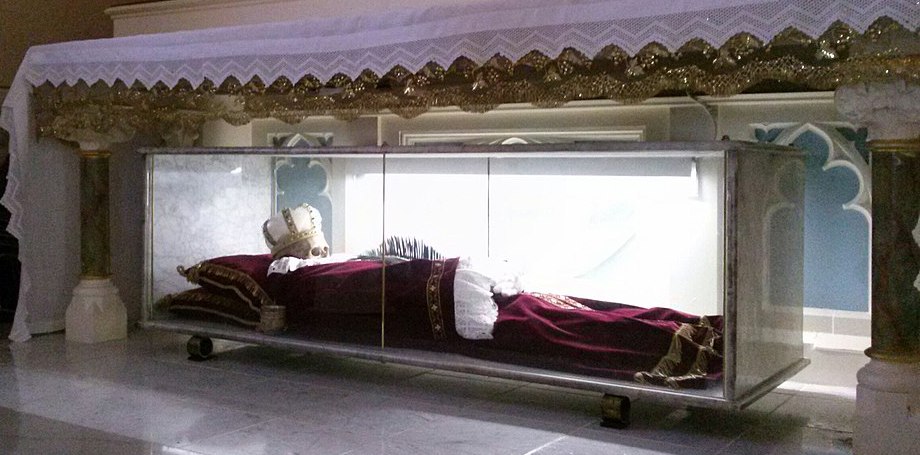
But what most Orthodox Christians in America likely don’t know is that there are at least twenty other Orthodox saints whose major relics are also present in America. And the reason they probably don’t know about them is that they are in Roman Catholic churches.
Just to be clear here, I am not talking about the many thousands (probably millions) of relic particles that exist all over the United States, nor even of various bones or large fragments one can find. I am speaking of either whole skeletons or significant body parts like a skull or hand, the kind of relic that is traditionally enshrined and made a place of pilgrimage.
I have titled this post The Other American Orthodox Saints, and I imagine some might quibble a bit with that title, because none of the saints I am about to tell you about ever spent time in America while they were living this mortal life. That shouldn’t bother us, though, because there are many saints in the Orthodox world whose relics are prized in countries they likely never visited and who in some cases even became the patron saint of that country. One example that comes to mind is St. Paraskeva of Iaşi, who spent her whole life in what is now Turkey and Jordan but whose major relics are in the cathedral in Iaşi, Romania. (I dare you to tell a Romanian she is not a Romanian saint!) Another is the Apostle Andrew, patron saint of Scotland, whose relics (including his skull) were brought there by St. Regulus (a.k.a. St. Rule) in the fourth century.
Anyway, whether you want to consider these saints “American Orthodox saints” or not (I do!), the fact that their major relics are here in America should be noticed by Orthodox Christians. So this article is a first attempt at presenting the research I’ve been doing over the past weeks on this topic.
Until recently, I had no idea about this myself, but while I was having dinner a couple weeks back with two of the monks from Holy Cross Monastery (Wayne, West Virginia), one of them told me about an American Orthodox saint no one seemed to know about. He told me that her full relics were in Ohio. I couldn’t believe it! So that started me down the research path. And I was amazed by what I discovered. Since it’s so astonishing, I’m sharing it here with you.
In the descriptions below I have included many links, including to articles about the saints so that you can learn more about them.
Full Sets of Relics
The saints listed here are present either with their full skeleton relics or at least with most of what is known to exist.
Louisville, Kentucky
The Shrine of St. Martin of Tours houses the relics of Ss. Magnus (feast day Aug. 19) and Bonosa (feast day July 13). While there is some small controversy over which saint named Magnus these relics belong to, the general consensus is that he was a third-century Roman centurion who was converted to Christ at beholding the martyrdom of Bonosa.
Their relics are fully visible under two side altars at the church in Louisville. While St. Bonosa’s full relics are present, St. Magnus’s skeleton is a bit short, but his skull and about 45% of his bones are present. Read the story of their relics here and here.
Cleveland, Ohio
A child-martyr named Christine (feast day Nov. 5 in the local Catholic diocese) has her full relics at the Resurrection Chapel of St. John Cathedral in Cleveland. This young martyr was perhaps 13 or 14 years old and killed for her faith around AD 300.
In the southern Cleveland suburb of North Royalton lie the full relics of St. Maximina (or Maxima) (feast day Mar. 26), the wife of a priest named St. Montanus, from Singidunum (modern Belgrade), martyred in AD 304. The two are celebrated together on the same day. In the same place is the martyr Hyacinth (feast day July 26), a young Roman man martyred in AD 109. They can be venerated at the Holy Protection Byzantine Monastery of the Poor Clares, which does not seem to have a website but is located at 6688 Cady Rd. in North Royalton. Given St. Maximina’s point of origin, one could also consider her to be a Serbian Orthodox saint.
Maria Stein, Ohio
In addition to countless relic fragments, The Maria Stein Relic Shrine, about an hour north of Dayton, holds the complete relics of two martyrs of the early Church — Ss. Victoria of Córdoba (feast day Nov. 17) and Concordia (feast day Aug. 13).
St. Victoria was a virgin-martyr of the early fourth century in Spain (AD 304), while St. Concordia was the foster-mother of St. Hippolytus, a prison guard who buried the body of St. Lawrence the Archdeacon of Rome. She was martyred in AD 258.
Washington, DC
Located in northeast Washington, DC, the Franciscan Monastery of the Holy Land in America, boasts impressive gardens and replicas of locations in the Holy Land. It also includes its own catacombs, and enshrined within them are the full relics of two saints — the second-century martyr Benignus and a child-martyr called Innocent, also from the second century.
St. Benignus is held to be a Roman soldier who was martyred for his faith, and most of his relics except for his skull are inside an altar at the monastery. St. Innocent was likely around seven years old at his martyrdom, and while there is a wax effigy encasing his relics, some of the actual relics are visible at their location inside an altar. His true name is unknown, but the tomb found in the Roman catacombs included the inscription “Innocent Resting in Peace,” so he has been called by this name since his discovery, when a vial of his blood was found (also present at this monastery in DC), a common practice in the Roman catacombs.
South Bend, Indiana
The Reliquary Chapel of the Basilica of the Sacred Heart on the campus of the University of Notre Dame houses the full relics of the third-century child-martyr Severa (feast day Jan. 29). St. Severa was from a family of saints, with her parents Maximinus and Secunda and her brothers Mark and Calendine all being celebrated together with her on the same feast day. The shrine holds the lion’s share of her relics in two reliquary boxes, with a wax figure of the saint functioning as something of an icon above those reliquaries.
Los Angeles, California
In the Cathedral of Our Lady of the Angels, one finds a chapel dedicated to the third-century virgin-martyr Vibiana, whose relics were formerly in the catacombs in Rome, in a tomb inscribed with “to the soul of the innocent and pure Vibiana.” The former Roman Catholic cathedral in Los Angeles was dedicated to her, though the church has been sold and is now an event venue. The relics were moved to the current cathedral, dedicated to Our Lady.
Dubuque, Iowa
The full relics of the child-martyr Cessianus can be found at the Cathedral of St. Raphael in Dubuque, Iowa, under one of the altars. Cessianus was martyred at the age of eight under the persecution of the emperor Diocletian in the early fourth century.
New York, New York (Manhattan)
The Church of the Most Holy Redeemer on Third Street in Manhattan is home to the full relics of the martyr Datian (feast day Oct. 30), one of the many martyrs whose tomb was found in the Roman catacombs and thus added to the martyrology. He is possibly a martyr killed during the persecution of Diocletian (early fourth century). Like many relics in Roman Catholic hands, his are encased in a wax effigy. It seems likely that his was the first full set of relics to be brought by Catholics to America.
Other Major Relics
These remaining saints have major relics present in America, more than just a bone or fragment, but not the full skeleton.
Pittsburgh, Pennsylvania
St. Anthony Chapel in Pittsburgh houses thousands of relic fragments, but notable among them are the skull of St. Macarius of Jerusalem (feast day Mar. 10). This relic’s presence is Pittsburgh is probably something of a shock to learn about for an Orthodox American, since St. Macarius (not to be confused with the better known Macarius the Great of Egypt) is one of the Holy Fathers of the First Ecumenical Council, and he also accompanied St. Helen in her discovery of the True Cross. He is the bishop featured on the icon of the Elevation of the Cross.
Another less-known saint with a large portion (not clear how much, but possibly all) of his relics at this chapel is the fourth-century martyr Demetrius, possibly of Rome. (This is not the much more famous Demetrius of Thessaloniki.) It’s not clear which early saint by this name this is, so I couldn’t find his feast day.
At this same chapel are the skulls of some of the Companions of St. Ursula (feast day Oct. 21). She was a fourth-century Romano-British virgin martyr who is (very interestingly!) the namesake of the Virgin Islands.
Chicago, Illinois
At the Shrine of All Saints at St. Martha of Bethany Catholic Church in Morton Grove, Illinois (Chicago area), there are many relics, but chief among them is the cranium (most of the top of the skull) of the hieromartyr Fructuosus of Tarragona (feast day Jan. 21), who was martyred in AD 259. He served as a bishop on the coast of Spain in the third century and was killed along with his deacons Ss. Augurius and Eulogius.
At this same shrine is the skull of St. Remaclus (feast day Sept. 3), a seventh-century Benedictine monk and missionary bishop who hailed from Aquitaine in France. He was the successor of St. Amandus of Maastricht and took up his episcopal see in Belgium. He died between AD 671 and 676.
In another part of Chicagoland, at the Dominican Shrine of St. Jude Thaddeus in Chicago proper is the arm of the Apostle Jude (feast day June 19), who was a relative of Christ Himself, possibly through his foster-father St. Joseph the Betrothed. This relic is sometimes taken on tours of the US, so check before you go.
Thibodaux, Louisiana
Finally, at St. Joseph Co-Cathedral in Thibodaux, Louisiana (about 90 minutes from either New Orleans or Baton Rouge), is the arm of St. Valeria of Milan (feast day Apr. 28), who was a first- or second-century martyr from northern Italy, possibly one of the first converts there to Christianity, and the wife of St. Vitalis. She and St. Vitalis are also the parents of another pair of martyrs, Ss. Gervasius and Protasius.
Conclusion
My intention with this article is to give a brief sketch of the locations of these major relics of Orthodox saints which are here in the United States and yet seem to be virtually unknown to American Orthodox Christians.
I hope this article will spur my fellow Orthodox Christians in America to make pilgrimages to these places and to venerate these saints in various ways — with hymns, feasts, icons, churches, etc., particularly if one of these saints is somewhere nearby. There is nothing wrong with visiting a Roman Catholic church for this purpose, and St. John Maximovitch is known to have encouraged exactly this to his flock when he was serving in Europe.
A number of these saints have Orthodox hymns written to them, while others are less-known and do not have any hymnography particularly dedicated to them. That said, there are generic hymns to martyrs and so forth that one could also bring to these places so that these saints will be venerated in proper manner by the Orthodox Christians of our land.
The Orthodox pilgrim should note that many of these relics, especially the full-body relics, are encased in or next to wax effigies of the saint, which may feel strange for those used to encountering relics in an Orthodox context, where this is not done. It should also be noted that (very unfortunately for the Orthodox Christian) many or most of them are not accessible to be venerated by kissing or touching them, unlike most Orthodox shrines, where it is usually possible to touch a glass case or reliquary containing the relic. I see this as a “museumification” of relics that is seen in Roman Catholic contexts, particularly pronounced where there are large collections of hundreds or thousands of relics. Nevertheless, one can stand at these relics and pay the saints honor as best as one can. It is a blessing indeed simply to be in their presence and pray.
If you know about more saints like this who have major relics here in America, please comment and let me know. (UPDATE: I have added more saints to this list, thanks to some of you! Saints added: Benignus, Cessianus, Christine, Datian, Hyacinth, Innocent, Maximina, and Vibiana. I also corrected the reference to St. Macarius, which incorrectly indicated this was the Egyptian monastic saint rather than the bishop of Jerusalem, based on some faulty information I had read elsewhere.)
All Orthodox saints of America, pray for us!


Leave a Reply