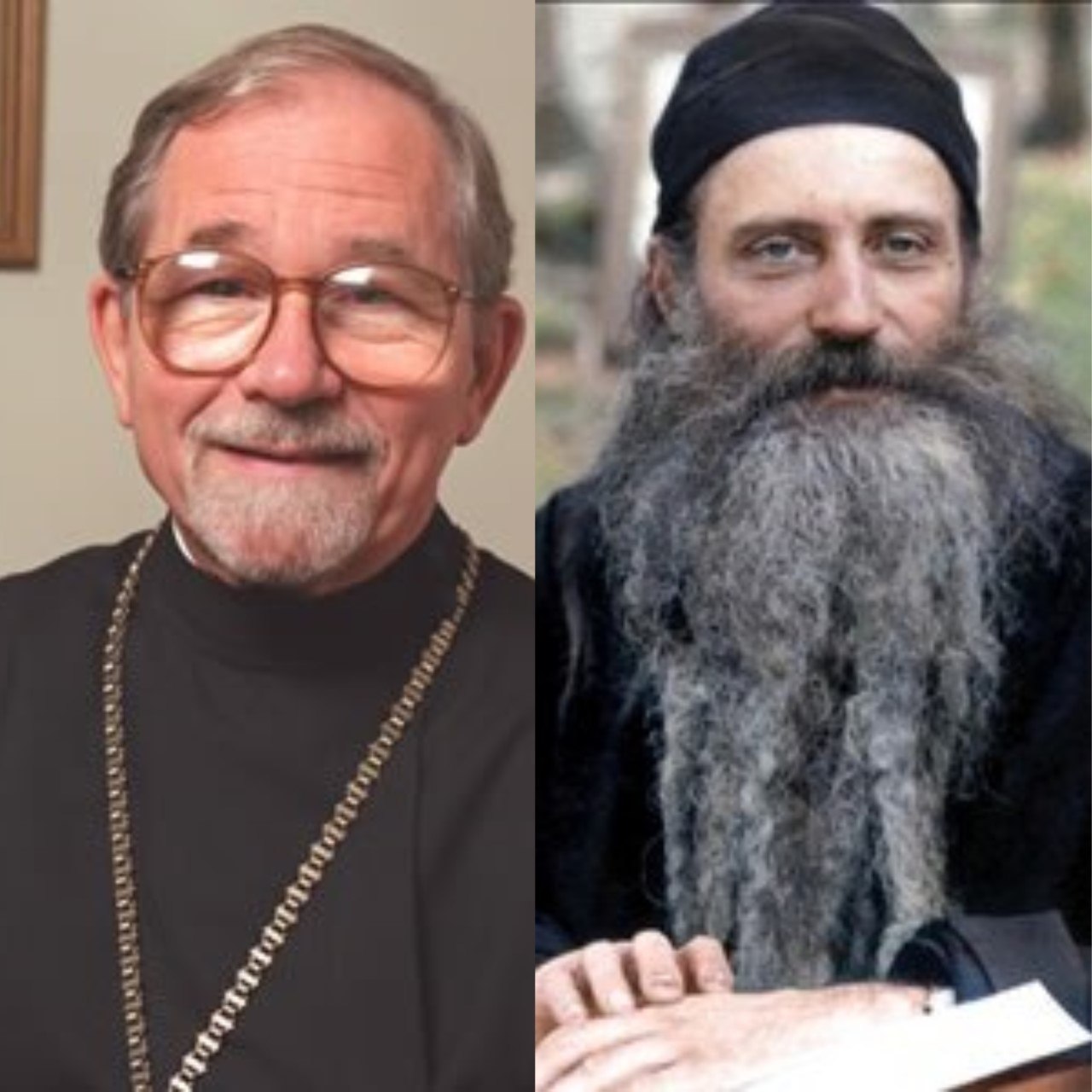
If ever a human being lived on this earth who sought God with his whole heart, whatever sins or errors he may have had—and as the Orthodox requiem service says, there is no man who lives who does not sin—it was Fr. Seraphim Rose.– Fr Thomas Hopko
To many familiar with either St Vladimir’s Seminary or Fr Seraphim Rose, it may come as a surprise that, in 2002, Fr Thomas Hopko — then-dean of SVS and son-in-law of Fr Alexander Schmemann — visited St Herman of Alaska Monastery in Platina, California and gave the homily at the memorial liturgy for the 20th anniversary of Fr Seraphim Rose’s repose. (There’s actually some video of this liturgy, which took place on top of the grave of Fr Seraphim on September 2, 2002.) The full text of Fr Hopko’s remarkable homily is below.
***
In the name of the Father, and of the Son, and of the Holy Spirit.
The Divine Liturgy is always the same. Whether in a magnificent cathedral on a great feast of the Church, or in the outdoors here at this humble monastery, the Divine Liturgy is always the same. What we pray is always the same, what we hear is always the same, what we see is always the same. The divine reality into which we enter is exactly the same. It is the reality of the Church, of life in Christ, of God’s Kingdom.
Every time we gather as the Church for the Divine Liturgy we are given to know the same truth. We know that we are boundlessly loved by God. We know that God is with us, and that we are with Him Who is gracious and merciful, slow to anger and abounding in mercy (Psalm 144:8). We know that God the Father Almighty is with us in the per- son of His Divine Son and Word, the Lord Jesus Christ Who is “light from light, true God from true God,” Who has done all that He can to save us. In Christ everything that God can say has been said; everything that He can do has been done; everything that He can reveal has been revealed; everything that He can give has been given. It is just for us to receive it, to believe it, and to rejoice in it forever.
At the same time, however, every celebration of the Divine Liturgy is not the same. It is always completely different. It is always absolutely unique. Each Divine Liturgy is not at all the same as any Liturgy that has ever been served before, or will ever be served again. Never before and never again will the Divine Liturgy be celebrated on the twentieth anniversary of the repose of Fr. Seraphim Rose. Never before and never again will those of us who are here be gathered for the Holy Eucharist in this setting.
From all eternity God saw this unique moment, never to be repeated. He saw that we would be here today. By His inscrutable Providence, according to His unsearchable ways—as the heavens are high above the earth, so different are the ways of God from ours—God has given us His unspeakable Grace to celebrate this Eucharist over Fr. Seraphim’s tomb. The uniqueness of this Liturgy is given to us, in a sense, therefore, not only by the Merciful God. It is also given to us by Fr. Seraphim himself. We would not be here right now—surely I would not be here—if it were not the twentieth anniversary of Fr. Seraphim’s entrance into eternal life.
The deacon just read the Gospel. We heard the words: He Who hears My word and believes in Him Who sent Me has everlasting life (John 5:24). We believe in Jesus Christ, and in God the Father Who sent Him. We cannot die. We believe in Him and enter into life. We also heard the words of the Apostle Paul: If we live, we live to the Lord, and if we die, we die to the Lord; so then, whether we live or whether we die, we are the Lord’s (Romans 14:8). We who are the Lord’s are here to-day because twenty years ago this day Fr. Seraphim entered into everlasting life. We who are the Lord’s are celebrating this Holy Eucharist today, humanly speaking, because of him. Therefore it is our faith that there is also Fr. Seraphim’s unique word that we have to hear today. We have to hear what he is saying to us now from beyond the grave. This, too, is a word that was never spoken before and will never be spoken again; a word that was never heard before, but will remain forever heard in our hearts. It is God’s unique word given to us through Fr. Seraphim, for this particular moment. It is a word given to us today for our salvation. This is our faith.
In his letter to the Romans, the holy hieromartyr, St. Ignatius of Antioch, the God-bearer, said that when we love a person’s human life in this world, we receive only an echo or a sound from God, but when the person dies, especially when he enters into life through a martyr’s death, then it is God’s word that resounds in that person. St. Ignatius also said in the same letter another interesting thing. He said that he wanted to die as a martyr so that he could finally be, he said, not a Christian or a saint, but that he could finally be a real human being (anthropos, chelovyek). When a faithful person dies a faithful death, he becomes himself God’s living word and living icon. All that belongs to this age passes away. All that pertains to one’s fallen humanity is gone. What remains is the shining divine image, the unique divine word. And certainly Fr. Seraphim, for every single one of us here today, is a unique word from God. But he is not the same unique word for every one of us.
I did not know Fr. Seraphim personally. I never met him or saw him or heard him. I saw his photographs and read his words. But I my- self, with each person here today, must pray to God and beg that we would hear what God is trying to say to each one of us through Fr. Seraphim. And it may just be—excuse me, but I believe that it truly is—that, according to Divine Providence, God will surely give each one of us the word that we need to hear.
Today is the first Monday of the eleventh week after Pentecost. We have the regular readings appointed for this day, in addition to those specially provided for the departed. We believe that by Divine Providence we were meant to hear the readings assigned for this Mon- day. God wants us to hear these words in connection with Fr. Seraphim’s life and death. The epistle reading (2 Cor. 2:4–15) begins with the words that my joy may be the joy of you all. There is no doubt that Fr. Seraphim would want his joy to be the joy of us all. Then it goes on to say and so I wrote to you (we might say on Fr. Seraphim’s behalf that he wrote for us) out of much affliction and anguish of heart and with many tears. I think that this is true of Fr. Seraphim. He could truly say to us that in this very place he wrote for us out of much affliction and anguish of heart, and with many tears. Then the Apostle’s letter continues not to cause you pain. When one reads Fr. Seraphim’s writings one may often be caused great pain; but he surely did not write in order to cause pain.… Not to cause you pain, but to let you know the abundant love that I have for you. But if anyone has caused pain, he has caused it not to me, but in some measure to you all.
St. Paul wrote this Second Letter to the Corinthians concerning a man who had to be put out of the community. He said that he wrote not to cause worldly grief (tou cosmou lypi), but rather to cause godly grief (kata theon lypi, in Slavonic pechal po Boze), that is, sadness according to God. So if pain or sadness must come upon us today, let it be for our repentance, for our salvation, for our healing and cleansing (cf. 2 Cor. 7:10). In our reading this morning St. Paul says, If anyone has caused pain … forgive and comfort him. And the Apostle continues: And this is why I wrote, that I might test you, to know whether you are obedient in everything. Anyone whom you forgive, I also forgive. What I have forgiven, if I have forgiven anything, has been for your sake in the presence of Christ, to keep Satan from gaining the advantage over us; for we are not ignorant of his designs.
Indeed, we are not ignorant of Satan’s designs!
There will be pain. There will be sadness. Even as we celebrate this Liturgy—I think that we must be candid—there is also a special kind of sadness today. This also is spoken about in the epistle passage we just heard. St. Paul said, When I came to Troas to preach the Gospel of Christ, a door was open for me in the Lord, but my mind could not rest (in Greek I think it says I had no rest in my spirit) because I did not find my brother Titus there (2 Cor. 2:13). Today God opened the door and allowed us to be together and allowed me to preach, but there’s a sadness in my spirit because we do not find our brother Herman here. We beg God, Whose ways are unsearchable and inscrutable, that we would love and forgive and pray … and come together in unity. We beg God, in ways known to Himself, that He would do what we can’t. If I can be standing here over Fr. Seraphim’s grave preaching this sermon today and celebrating this Liturgy—if that miracle can happen—then any miracle can happen. We believe in miracles. Who is so great a God as our God? Thou art the God Who works miracles (Psalm 76:13–14).
We also heard the regular daily Gospel today. It warns about scribes and Pharisees, hypocrites, blind guides … and so on. It says, You shut the Kingdom of Heaven against men; for you neither enter your- selves nor allow those who would enter to go in…. You traverse sea and land to make one convert, and … you make him twice as much a child of hell as you are yourselves (Matt. 23:13–15). This is Jesus speaking. It is terrible. And terrifying. We know that it is written for us today. When we hear it, we can only say, “O Lord, be merciful to me, a sinner!”
Another providential thing happened today, something that I did not at all expect. At the Midnight Service which the nuns just read before the Divine Liturgy (which I did not know would be read) we heard the entire Psalm 118. This is the psalm sung in its entirety at the vigil of Great and Holy Saturday (usually done on Great and Holy Fri- day night) over the tomb of our Lord Jesus Christ. When I was thinking of Fr. Seraphim through the night, not being able to sleep, praying for God’s word to be given, it was Psalm 118 that kept coming to me. Blessed are they whose way is blameless, who walk in the law of the Lord. Blessed are they who keep His testimonies and seek Him with their whole heart (Psalm 118:1–2). If ever a human being lived on this earth who sought God with his whole heart, whatever sins or errors he may have had—and as the Orthodox requiem service says, there is no man who lives who does not sin—it was Fr. Seraphim Rose. And the psalm continues, How can a young man keep his way pure? By guarding it according to Thy word. And it also says, With my whole heart I seek Thee, O Lord, let me not wander from Thy commandments (Psalm 118:9–10).
Fr. Seraphim loved Blessed Augustine. I just bought the book that he wrote (The Place of Blessed Augustine in the Orthodox Church). In fact, I already have it; but I got another copy. St. Augustine said somewhere that Holy Scripture teaches that true seekers for God are already blessed. Those who hunger and thirst for righteousness will surely be satisfied. Those who desire God with their whole heart are indeed already found by Him. How this works itself out occurs in the details of a person’s life, with prayer and fasting and the shedding of blood. But surely it is true. Those who seek God have already been found by Him. If ever there was a hungering, thirsting, seeking person on this planet, we know who he is today.
The Lord said, Keep asking, and you will receive. Keep seeking, and you will find. Keep knocking, and it will be open to you (Luke 11:9). We have the boldness—without even too much boldness—to say that this man asked and he received; he sought and he found; he knocked and it was opened to him. Indeed, he not only found, but he himself was found by God. And this is the only important thing: to be found by God. This too is the Apostle Paul’s teaching, in his first letter to the Corinthians, when he writes, If anyone thinks that he knows something, he does not yet know as he ought to know. But if he loves God, he is found by Him (1 Cor. 8:2–3). We believe that Fr. Seraphim loved God and was found by Him. When we knock, the door is opened. This is our faith.
So today we ask God to forgive whatever sins this hieromonk may have had, who worked so hard and wrote so much, with so much anguish of heart—for us. As we thank God at this Divine Liturgy for all things known and unknown, manifest and unseen, let us thank God for Fr. Seraphim; for his suffering, for his work, for his writing, for his prayers. Let us ask God to consign to oblivion whatever darkness or error might have been in him, as we thank God and offer His own to Him, “on behalf of all and for all.”
With all our hearts we thank God for this man who has caused us, humanly speaking, to gather here today to celebrate this Holy Eucharist. Amen.


Leave a Reply