Although his writings remain unpublished and are largely unknown today, the 18th century priest Masʿad Nashw deserves to be counted among the most significant Orthodox figures of his time. The descendent of an old Coptic family who at some point had settled in Damascus and converted to Chalcedonian Orthodoxy, Masʿad first came to prominence in the circle of Arabic-speaking intellectuals in the entourage of the Patriarch Sylvester of Antioch. In 1744, he arrived in Egypt where he became oikonomos of the Patriarchate of Alexandria. Because the patriarch was often away in Constantinople and Wallachia, in practice this meant that Masʿad was in charge of managing the everyday life of the patriarchate, which at that time counted only seven, mostly Arabic-speaking parishes.
The Orthodox of Egypt were closely connected to their coreligionists in Syria and were subject to the same intense pressures from Latin missionaries who often used underhanded methods to attract converts, as Masʿad himself frequently describes. In order to protect his flock, Masʿad wrote a large number of apologetic treatises, often in correspondence with prominent Melkite Catholic figures in Syria, and addressed pastoral issues caused by the missionaries in his impressive homiletic corpus (parts of which can be found online here and here). He also worked closely with the Greek theologian Eustratios Argenti and translated his treatises Against the Azymes and Against the False Infallibility of the Pope into Arabic, which were then printed by Sylvester in Wallachia. It is noteworthy, however, that nowhere in his writings does he support Argenti’s advocacy for the rebaptism of Latins, a practice that the Patriarch Sylvester at least tacitly rejected.
Given Masʿad’s strident opposition to the missionaries, who posed an acute existential threat to his flock, it is all the more interesting that he takes a very nuanced but sympathetic attitude toward the Copts. They are rarely mentioned in his sermons, except to point out that the fact that the Orthodox and the Copts share almost all the same beliefs and practices, despite over a millennium of separation, proves their apostolic origin in contrast to Roman innovations. He does, however, tackle the difficult issue of the Copts’ relationship to Orthodoxy in a response to a query from one of his parishioners. This response is in some ways a model for how to address theological difference sympathetically and objectively, but it also contains mistakes that illustrate the dangers of addressing extremely technical matters of theology without a full mastery of the terminology involved.
Masʿad begins by stating that there are no differences between the Copts and the Orthodox apart from the issue of whether there are one or two natures in Christ, and that this is something that from one perspective might be trivial but from another perspective is very serious. He then walks his reader through an account of the errors condemned by the Ecumenical Councils–those of Apollinarius, Nestorius and Eutyches–making it very clear that the Copts also reject these heresies. He concludes that their attachment to one-nature language in Christology is due to the general lack of learning in their community, and that their insistence on speaking of one nature in Christ is an “error of sophistry.” That is, a misuse of language rather than a genuine theological error, but nevertheless a problem that, if taken to its logical conclusions would lead to serious heresy.
Such a diagnosis might sound patronizing to modern readers, but it is true that the general level of education among all Egyptian Christians was quite low in the 18th century and there was limited access to patristic texts. Starting in the 17th century, however, in a movement often called the “Melkite Renaissance,” the Orthodox of Syria had made massive efforts to recopy manuscripts of medieval Arabic theological texts and patristic translations, and this process was continued by the Patriarch Sylvester, who personally corrected and revised the 10th century Arabic translation of John of Damascus’ corpus in order to improve the level of theological learning among his flock.
Masʿad’s understanding of Orthodox Christological language is clearly dependent on his reading of John of Damascus. He correctly understands hypostasis (uqnūm) as a concrete, numerically distinct individual and nature as a universal that only has real existence in individuals. He seems to attempt to give an account of the Damascene’s adaptation of the Tree of Porphyry in the Dialectica from memory, and so makes the rather weird mistake of equating “most specific species” (a universal that should be identified with nature) with the individual hypostasis. When he tries to give his own examples for hypostases having more than one nature, the results are confusing at best and at worst nonsensical, since water, fire, stone etc. are not normally countable and so make poor examples of hypostases and heat, coldness, moistness and dryness are, within this framework, qualities rather than natures. This confusion might be due to Masʿad having had some degree of medical education. Discussion of the four elements and their qualities was an important part of the ultimately Galenic system still taught in the Middle East at that time, and his sermons abound in medical and pharmacological analogies with a strong emphasis on Christ as healer. Since Masʿad is writing pastoral guidance for a member of his own community, rather than a polemical treatise, however, these slip-ups do not detract much from his broader point about the relationship between Orthodox and Coptic theology, but they likely would have bewildered a reader who took them as points of doctrine rather than imprecise illustrations of his argument. Likewise, his account of the deposition of Dioscorus and his replacement by the Chalcedonian patriarch Proterius would obviously not be accepted by a Coptic reader.
What makes Masʿad’s engagement with the Copts a model for modern interaction is that he took his observation about their lack of access to the writings of the fathers very seriously and, rather than engaging in polemic against them, made personal efforts to remedy the problem in cooperation with members of that community. Late in his life, in the early 1780s, he undertook a translation of the entire corpus of St Athanasius (a shared point of reference for Christology) as well as several works by St John Chrysostom. On the opening pages of his translation of Chrysostom’s commentary on the Acts of the Apostles, he thanks his sponsor, a Coptic archon named al-Ḥājj Jirjis ibn Jawharī, who “paid for it out of his own money and his abundant love for religious books… for the benefit of all Christians [li-nafʿ al-masīḥiyyīn muṭlaqan].”
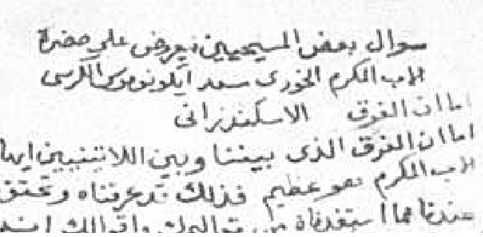
Below is a translation of Masʿad’s response to his parishioner, taken from MS Cairo, Coptic Orthodox Patriarchate COP 28-3 (pp. 265-273 of the pdf). This codex, which contains many of Masʿad’s writings against the Latins as well as various other texts, is put together from parts of several Chalcedonian Orthodox manuscripts and it is not clear whether the text of the response is truncated at the end, since it lacks a formal conclusion and does not include the citations from Coptic sources promised earlier in the text.
A question from a Christian submitted to the reverend father, the priest Masʿad, oikonomos of the See of Alexandria
As for the difference between us and the Latins, reverend father, it is great, as we have come to know and realized from your teachings and statements that there are around thirty things that they invented contrary to the teachings of the Gospel, the traditions [taslīmāt] of the Apostles and the traditions [sunan] of the Church. What we would like for you to help us with now is to know the difference between us and our brothers the Copts, since we have heard you say many times that their traditions are apostolic. Our purpose is to know how they speak of Christ as having one nature, one will and one activity without applying suffering to the godhead or how they speak of one nature from two without requiring confusion and the transformation of the two natures from their original substance. Please provide us with a response.
The response of the lowly priest Masʿad:
The difference between us and our brothers the Copts is but a single issue only pertaining to the economy of the incarnation of God the Word. On the one hand, we could say that the difference isn’t anything at all, but on the other hand it is very great. For from the perspective of belief [iʿtiqād] they do not contradict what we ourselves believe in any way, but from the perspective of creed [iqrār] and what they say about it, the difference is very great and it is opposed to their own belief. For this reason some say that the difference between us and them is only a dispute over words and expression and is not about the actual thing being discussed. For when they say that Christ our God is one hypostasis, perfect God and perfect man, and reject the language of transformation, change and confusion and any language of separation, what difference is there between us and them? Is this not precisely the view of Christ’s One, Holy Catholic and Apostolic Church?
However, when they say that the nature of perfect God and the nature of perfect man became one nature, one will and one activity, the difference between us and them is very great, since they speak of one nature from two natures, something that is contrary to the sound dogma that was passed down to us and to them.
Why is this? It is because differing [natures] do not become one nature without changing and transforming into another nature and another hypostasis and, following from this, another activity contrary to the initial activities. This is something that they themselves do not accept about Christ. One who says this is an unbeliever and divine scripture shows that he is a liar because the nature of each species is indicated by its activities. As for Christ’s wills and natures and their activities, they are undeniably declared in the Gospel. This is how we ascertain that each of the essences remains in Christ without transformation or change, preserving its property.
For union occurs in three ways. The first is what we mentioned above, that a nature cannot come into being from two or more natures without changing and transforming into another nature, like the transformation of the four elements into the human body and their changing into one nature that is different from the elements and different activities. I will show you this in another way: if we mix honey (which is sweet-tasting, hot and thirsty, causes fever and transforms into yellow bile) with vinegar (which is sour-tasting, sharp-smelling, dry and thirsty and transforms into black bile because it harms those with melancholy), a different hypostasis immediately appears, different from the two initial hypostases, and a different nature contrary to the two natures, since everything that indicates the nature of the thing (color, taste and smell) changes, and the activities change. So that which [previously] transformed into yellow [bile] suppresses it, [that which previously] harmed melancholics benefits them, the thirstiness cools and moistens, and it stops fever and brings sleep in cases of anxiety. This union of mixture is the opinion of Eutyches about Christ and it is speaking of one nature from two natures.
The second way is the union that occurs through accompaniment alone, where the two natures remain recognizable with the union and the two hypostases [remain] separate, like the union of gold [inlaid] on silver or solder on brass, where the two become one but each remains distinct in every other way. This is the opinion of Nestorius about Christ, since he spoke of two natures and two hypostases.
The third way is hypostatic union, in which two natures are found in one hypostasis, each nature preserving its property and activities intact while remaining united in one hypostasis without any confusion, transformation or separation. [This is] the union of the Word, who is immortal, with that which is mortal and the invisible and incorporeal with the corporeal and visible in the hypostasis of one person, without confusion, transformation, change or separation. This is the belief of Christ’s one, holy, Catholic and Apostolic Church about Christ, who is perfect God and perfect man, free of the imperfection that the wretched Apollinarius spoke of in the one hypostasis, and not in two hypostases, as the hypocritical Nestorius ventured in order to avoid the confusion that the unbelieving Eutyches advocated.
For the first to teach one nature in Christ was the hypocrite Apollinarius, since he said that the Son of God took from the holy Virgin a body without intellect and that the divinity in Him took the place of the intellect. For this reason, he said that He is one nature. However, the Second Ecumenical Council anathematized him, along with the rest of the heretics at that time. Our brothers the Copts do not accept this view and therefore they say that Christ is perfect God and perfect man, in accordance with the Church’s view, as we have previously said.
Then, after that wretched one, there appeared Nestorius, Patriarch of Constantinople, who, in order to refute the opinion of Apollinarius through his teachings, deviated from the right path in a different way. He spoke of two natures and two distinct hypostases, separating the divinity from the humanity and for this reason the wretched one did not want to say that the Virgin is Mother of God, so the holy Third Ecumenical Council cast him out, deposed him from his see, and anathematized him and his teachings.
After that wicked man, there appeared Eutyches, archimandrite of the See of Constantinople, whom the Arabs call Ūṭākhī. This wrongly-believing person, in order to avoid the opinion of Nestorius, revived speaking of one nature, for which the Church had condemned Apollinarius, inventing another way that goes against the doctrine of Apollinarius but is more absurd than it, since he speaks of confusion and mixture by speaking of one nature from two natures and one hypostasis from two hypostases. Jacob, called Baradaeus, and Barsawma were in agreement with this doctrine, and it was supported by Dioscorus, patriarch of the city of Alexandria and his fifteen bishops, who after their patriarch was deposed and defrocked, accepted the Fourth Council, which condemned Eutyches and his doctrine and deposed Dioscorus for his rebellion against the council since he did not attend it in order to absolve himself of the accusations against him. In his place, Proterius was consecrated as patriarch of Alexandria at the request of the bishops of the eparchy [i.e., patriarchate] present at the council.
Consider, my son, the poor state of the heretics and the correctness of the Church’s view. Apollinarius, Nestorius and Eutyches all spoke about the same issue. One [i.e., Nestorius] spoke correctly of two natures but contradicted the truth by speaking of two hypostases, and two [i.e., Apollinarius and Eutyches] spoke of one hypostasis, in accordance with the truth, but deviated from the correct path by speaking of one nature. Neither [of the two] agreed with the other, since one rejected the human nature and the other spoke of the confusion of the two natures. The Church, which is the pillar and basis of truth, did not accept the opinion of any of them, but rather anathematized them all and condemned their doctrines. Our brothers the Copts likewise reject the aforementioned ones and their teachings.
This hypostatic union we speak about in Christ, without confusion or separation—that is, the existence of two natures in Christ’s one hypostasis—not only exists in man, who is obviously composed of two contrary natures [i.e., soul and body], but also in the four elements, since in each one of them two natures are evident, as is also the case in every sort of plant. There is nothing in the world that God has not placed in its one hypostasis two distinct natures indicated by their contrary activities within the same hypostasis.
I say this because our brothers the Copts disapprove of speaking of two natures in Christ’s one hypostasis and are averse to it, although it has been passed down to them, as we shall explain from their own statements and confession. Their disapproval and aversion to it is due to the loss of learning among them. I mean no offense to them, since we did not receive speaking of natures and hypostases in the godhead and in the economy of the incarnation of the Word from holy scripture, but from the teachings of the holy fathers, the divinized [mutaʾallihīn] teachers of the Church who speak of matters connected to philosophy and the natural sciences, sciences that they mastered to the utmost extent, while the aforementioned group [i.e., the Copts], when learning was lost among them, became attached to an error of sophistry that leads to the teachings of Eutyches, whom they reject.
What is this error? It is their saying that nature is hypostasis and hypostasis nature and that each nature requires a hypostasis and each hypostasis requires a nature. The matter is contrary to what they say, since we see in the one hypostasis of water coldness and moisture, in the hypostasis of the sun heat and dryness, in the hypostasis of wind heat and moisture, and in the hypostasis of stone coldness and dryness. There is no one nature to be found in one hypostasis at all, but rather two or more whose existence is ascertained through their activities, as we have said. Thus you have come to realize that their statement that each nature requires a hypostasis is an error, as is witnessed by the composition of a human being, who has two natures in his one hypostasis.
This is the error that causes them to be in great fear, as the prophet says, where there is no fear [cf. Psalm 53:5]. They say that if they were to say that Christ is two natures they would fall into the unbelief of Nestorius, who spoke of two natures and two hypostases. However, their saying that nature is hypostasis is nature is not only a blatant error in itself, but absurd and opposed to the truth of theology. For if we judged that nature is hypostasis and hypostasis nature, we would necessarily be required to speak of the super-natural Trinity as being three natures, since it is three hypostases, or to deny the three hypostases and say that [the Trinity] is one hypostasis. In either case, we would be committing unbelief [nakfur] since the nature of the godhead is one in three hypostases. In any case, saying that nature is hypostasis and hypostasis is nature is a blatant error and that is clear.
Pay close attention with no ulterior motive, so that we may learn the difference between nature and hypostasis, since it is great. The philosophers say that nature is the principle of motion and rest, while they say that hypostasis is that which does not divide. This is something that you will not understand and you will need someone to explain to you at length, and it is not the intended meaning here.
As for myself, I say that nature is the existence that is the most generic genus and hypostasis is the most specific species, which is the individual that cannot be divided. The most generic genus exists in all species into which it divides, and the species only exists in itself. The nature that is existence divides into substance and accident. Accident does not exist without substance, but rather exists [in it]. As for substance, it is a species of nature and also a genus, since it divides into corporeal and incorporeal. Incorporeal is the super-natural godhead [… part of this passage is illegible]. The nature of the Father, Son and Holy Spirit is one, while the hypostasis of the Father is not the hypostasis of the Son or the Spirit. Then, the angels, demons and the rational soul. Likewise, the nature of the angels is one and exists in each of them. However, the hypostasis of Michael is not the hypostasis of Gabriel.
Corporeal is also a species of the substance and genus because it divides into animate and inanimate. Inanimate is the four elements which have one nature and each element is different from the others and is only found in itself. As for animate, it is a species of corporeal and is also a genus because it divides into sensate and insensate. Insensate is plants, in which the entire nature exists, while each individual plant exists in itself and is not found in anything else. As for sensate, which is animals, it is a species of animate and also a genus of rational and irrational. Rational and irrational are most specific species because neither rational nor irrational divides. Therefore the nature of rational animal entirely exists in Peter, James and John. The hypostasis of Peter is not found in anyone else apart from itself alone. The nature of irrational animal exists entirely in [the individual] horse, camel and donkey, while not one of them is found in anything apart from itself.
You have learned that nature is universal [ʿāmma] and hypostasis is particular [khāṣṣ] and have realized that nature is not hypostasis and hypostasis is not nature. So to speak of two natures—that is, perfect divinity and perfect humanity—in Christ’s one hypostasis saves you from any fear of falling into Nestorius’ unbelief, since not every nature requires a hypostasis, as we have demonstrated, nor is nature hypostasis and hypostasis nature, as mistaken people claim. Speaking of one nature in Christ is the same doctrine as Eutyches, because there is nothing that can come about from two natures except through transformation. This is the view that the Church condemns, as do our brothers the Copts, who do not accept this view [i.e., that of Eutyches], do not believe it, and do not claim it. The reason for [their belief in one nature] has no other cause than an error of sophistry that they cling to due to the loss of learning among them, as I have said previously, and the loss of the works of the holy fathers, the teachers of the Church and trumpets of the Spirit.


Leave a Reply