This article also appears on the new Orthodox History Substack. Go to orthodoxhistory.substack.com to subscribe.
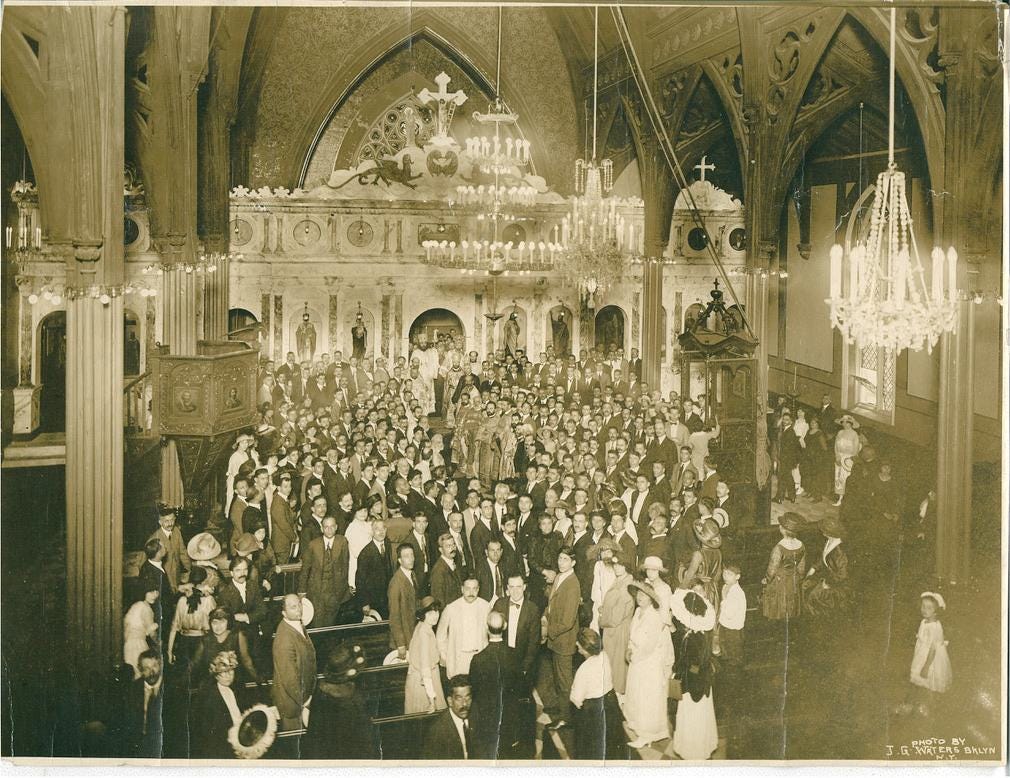
Pews are a common sight in Orthodox parishes in America. Not all parishes, but a large share of parishes in the Greek and Antiochian Archdioceses, as well as some in the OCA and other jurisdictions, have pews that line the center of the nave. The story I always heard growing up went something like this: early Orthodox communities tended to buy former Protestant churches, and those churches had pews, so the Orthodox just adopted them.
This is not really true.
Back in 2009, when I was just getting started publicly writing about church history, I decided to test the old theory by focusing on early Greek Orthodox churches in America. Firstly, is it true that those early churches were mostly repurposed Protestant buildings?
No. In a 1913 book called Greeks in America, Thomas Burgess identified sixteen Greek churches that were built by the community, versus twelve that were purchased from Protestants:
The churches actually erected by the Greek communities, most of them constructed after the correct Byzantine pattern, number sixteen: Lowell, Boston, Ipswich, Massachusetts; Manchester, New Hampshire; Newark, New Jersey; Charleston, South Carolina; Tarpon Springs, Florida; Chicago (2); Sheboygan, Wisconsin; Minneapolis, Minnesota; Pueblo, Colorado; Salt Lake City; Portland, Oregon; San Francisco; and also one in Montreal. Those buildings bought, formerly Protestant and a few Anglican, number twelve: New York (1); Philadelphia; Nashua, New Hampshire; Providence, Rhode Island; Pittsburg; Baltimore; Atlanta; Savannah; Birmingham; Chicago (1); Milwaukee; Denver.
I did my own research into the same question back in 2009 and found a similar ratio: fourteen built against nine bought. So, for the Greeks, most early church buildings were not repurposed heterodox structures.
So when did pews come into the picture? To answer this, I conducted, back in 2009, a fairly involved investigation, using newspaper archives, parish histories, and phone calls to the churches themselves. Here’s what I found — supplemented by additional research I’ve done since then.
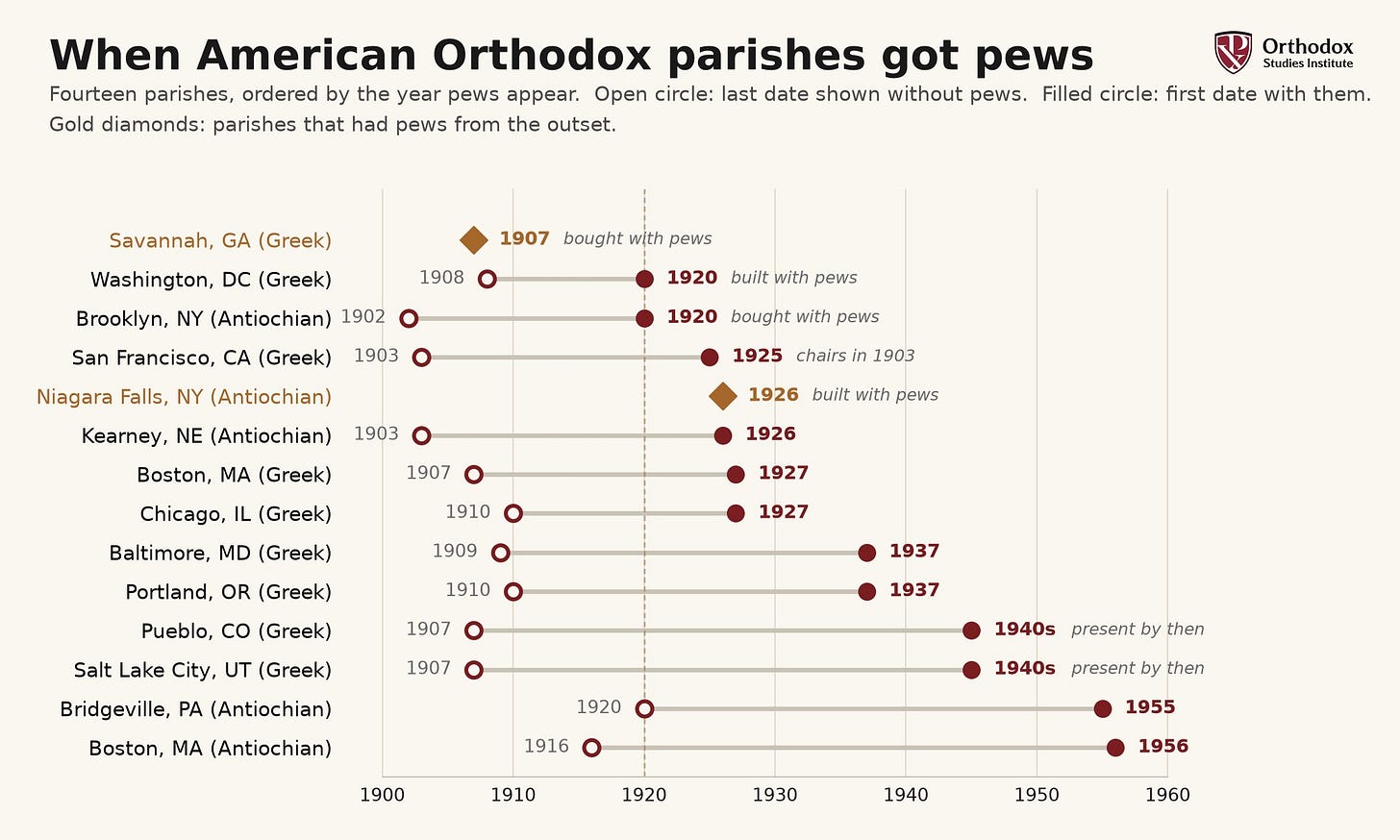
One of the only early churches I found that followed the old story — bought a Protestant church, kept the pews — is St Paul’s Greek Orthodox Church in Savannah, Georgia. In 2009, I spoke with Nick Donkar, who was born in 1914 and was a lifelong parishioner of St Paul’s. Mr. Donkar, who died within weeks of our conversation, told me that the original St Paul’s was purchased from an Episcopal church in 1907 (in fact, that’s how they got the name, “St Paul’s” — they retained the Episcopal church’s name of the building). Since the newly-purchased church had pews, the community retained them; however, men and women sat separately in those early years. This is one of the first churches I have been able to document as having pews.
A similar pattern occurred in Baltimore, but much later than in Savannah. In 1909, Annunciation Greek Orthodox Church purchased its first building, but they did not use pews in this structure. In 1937, the parish moved to a new location — formerly a Congregationalist church. In his history of the Baltimore Greek parish, Nicholas Prevas writes,
In the Old World, Orthodox churches did not have pews. At Homewood Avenue, the congregation had followed this tradition with the men standing on one side and women standing on the other. Their new church, however, featured three sections of beautifully carved oak pews for seating up to 750 people during worship services and additional theatre-style seating for over 275 more in the balcony area.
By 1937, pews were an increasingly common feature of Orthodox churches in America.
And then there’s St Nicholas Cathedral in Brooklyn, the mother church of the Antiochian Archdiocese. In 1902, St Raphael Hawaweeny acquired a former Swedish Lutheran church on Pacific Street in Brooklyn to be the new cathedral for his Syro-Arab Mission. Whatever the previous owners had going on, by the time the cathedral was consecrated as an Orthodox temple in November 1902, there were no pews: the New York Sun (11/10/1902) wrote, “As there are no seats except along the sides of the building most of the congregation had to remain standing throughout the service.”
St Raphael died in 1915, and his eventual successor, the ill-fated Aftimios Ofiesh, moved the cathedral to a new building on State Street in 1920, purchased from the Episcopalians. And this time, the Protestant pews were retained.
And that’s basically it — I’m sure they exist, but I haven’t found any more positive evidence for the story that early Orthodox communities purchased old Protestant churches and kept the pews. On the other hand, there’s a load of evidence that early Orthodox parishes generally did not have pews, and began to add them in the 1920s. In fact, of the three examples of the old story I mentioned above, only Savannah predates 1920, and both Baltimore and Brooklyn purchased Protestant churches and didn’t keep the pews, then later purchased other Protestant churches and did.
St Sophia Greek Orthodox Church was founded in Washington, DC in 1904. In 1908, the Washington Herald (11/1/1908) wrote,
In the back of the church are seated women and children. No other seats are used, and the men of the congregation stand on the sides of the room with a broad open aisle down the middle. […] Nearly 100 men are present, and standing bravely among them is a tiny chap in a blue sailor suit, who manfully stands throughout the whole service, a funny little imitator of the actions and gestures of his elders.
In 1920, the Washington Greeks built a new church, and this one did include pews. The Washington Post (8/8/1920) said, “The church is designed to seat 600 in the main auditorium.”
On the other side of the country, Holy Trinity Greek Orthodox Church in San Francisco purchased 24 chairs in 1903. It does not appear to have had actual pews at this point. By 1925, the church did have pews. All of its buildings were constructed by the parish, as opposed to being purchased. (My source for this was Jim Lucas of the Holy Trinity Historical Society.)
The first priest ordained by St Raphael was the great missionary Fr Nicola Yanney, whose base was St George Syrian Orthodox Church in Kearney, Nebraska. The original church building was an old school, which the community bought for $125 and physically picked up and moved to land that they owned. There is no evidence that this original church had pews. Fr Nicola died in 1918, and in 1923, the parish built a new church. According to an old parish history, in 1926, they purchased pews from a local Episcopal church.
Annunciation Greek Orthodox Church in Boston erected its first temple in 1907, and its second in 1924. Neither structure had pews; however, in 1927, pews were added.
Another Boston church was St John of Damascus, an Antiochian parish established by St Raphael Hawaweeny in 1907. This church built a proper temple in 1916, and according to the parish history, “There were no pews in this Church, only the booth-like chairs which lined the left and right walls. The ‘elder men’ sat on the right side and the older women on the left. The other members of the parish stood up through the entire Divine Liturgy. The small balcony was reserved for very young children and widows.” In 1956, the community built a new church. The parish history tells us, “The new Church was to have pews; an innovation much anticipated with joy, and would seat 300 people.”
Here’s something interesting. In 1917, St Nicholas Greek Orthodox Church in St Louis, Missouri purchased a building from a Lutheran parish. Presumably the Lutherans had pews, but they must have been removed, because once the Greeks acquired the building, there were no pews. The parish council decreed that women were to sit in the balcony, separate from the men. From a previous version of the parish website:
In a sign of the times, it is interesting to note that discussions at several parish council meetings during this era involved the place of women in the Church: Woman’s place, they decided, was in the balcony – unless it was full – in which case they would be permitted to sit on the main floor. Needless to say, the fairer sex was not amused. However, the Council stood by its decision. A few years later, a new seating arrangement evolved with women sitting to the left of the main aisle and men to the right. By the 1950’s, families began to sit together in worship.
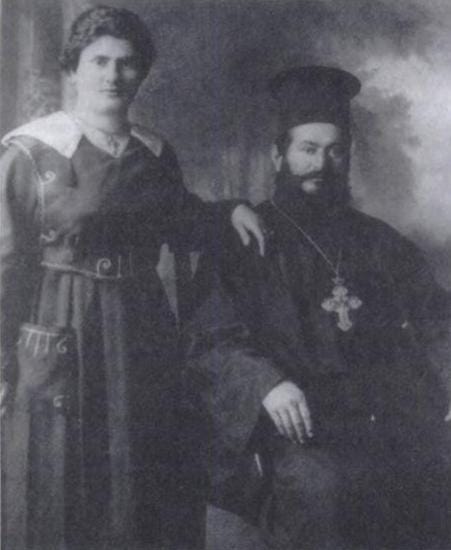
In 1920, Fr Mark Petrakis took over as pastor of the community. From the old parish website: “Father Petrakis introduced chairs for parishioners in the nave. This became a controversial matter because parishioners were accustomed to standing during the entire Liturgy, with a few ‘stadia’ (wall stalls) provided for the elderly.” This is the first direct reference I’ve yet found to a controversy over church seating.
In the mid-1920s, Fr Petrakis moved to Saints Constantine & Helen Church in Chicago. The community’s first building had been constructed in 1910, and it did not have any pews. In 1926, that original church was destroyed by fire. Presumably under the direction of Fr Petrakis, the new church was built with pews (and a communion rail) in 1927-28. From the parish history (no longer public, but available via the Wayback Machine): “The new church not only evolved into one of the most beautiful Greek Orthodox churches of its time but also became an innovative influence for future churches. In addition to a new communion rail, church pews were installed.”
A communion rail?
Petrakis was one of the most enthusiastic adopters of Western features in Greek Orthodox churches — not only pews and that communion rail, but also organs and mixed choirs.
The Greeks of Salt Lake City built their first church in 1905. A couple of years later (5/6/1907), the Salt Lake Herald reported, “There are no pews or benches in the Greek church, the reason being that the communicants prefer to show their confidence in the faith by standing for hours in a single position during the services.” In the mid-1920s, the community built a new church. According to the late parish historian Constantine Skedros, this building did have seats, but originally, they were lines of chairs, rather than pews. At the beginning, men and women were separated. In the late 1940s, the parish added regular pews.
Built in 1907, St John the Baptist Greek Orthodox Church in Pueblo, Colorado is one of the oldest surviving Greek Orthodox church buildings in the United States; in fact, it might be the oldest such building west of the Mississippi. Originally, the church had no pews. Instead, “stadia,” or leaners lined the walls of the nave. These seem to have been a common feature of early Greek churches in America, and they remain ubiquitous in Greek monasteries. I can’t pin down exactly when the Pueblo church added pews, but they were present by at least the 1940s. Fortunately, the parish kept a few of the leaners as historical artifacts.
Like the church in Pueblo, St Sophia in Los Angeles originally had leaners along the sides of the nave. From the Los Angeles Times (4/8/1917):
In the center of the church there are no seats. The congregation stands or kneels during the services. The aged or infirm, who cannot stand, are provided for by seats placed along the walls on both sides. These seats are high, with arms on which the worshiper may support himself while yet remaining in a standing position, if possible, but there are narrow seats that may be folded down and used if necessary.
Holy Trinity Greek Orthodox Church in Portland, Oregon was built in 1910. In 1921, the Oregonian (12/25/1921) said, “In the interior the main floor is for the men and the women and children have the gallery for their use. This is provided with seats, but on the main floor there are only a few seats for the use of aged persons or cripples.” In the late 1920s / early 1930s, the parish added chairs to the church, and in 1937, pews were installed.
Annunciation Greek Orthodox Church in Minneapolis was also built in 1910, and their longtime pastor, the late Fr Anthony Conairis, told me that the church originally had folding chairs. Men and women were separated, with women sitting in the balcony. This persisted until the mid-1920s. Eventually, the chairs were replaced with pews (though in which church, I’m not sure; the parish has had five different buildings in its history).
Shortly after Assumption Greek Orthodox Church was built in Pawtucket, Rhode Island in 1913, the Providence Journal (3/30/1913) wrote, “Attending mass at this church would be a severe trial for one not accustomed to the Orthodox Church seeing that there are no sittings except for the very aged and infirm. For three and one-half hours the congregation stands while the impressive service is conducted and Papa George delivers the sermon.” By 1949 at the latest, Pawtucket had pews (documented in the Pawtucket Times, 6/30/1949), but we don’t know when they were installed.
St George Orthodox Church was established in Niagara Falls, New York in 1922. It was originally under Bishop Aftimios Ofiesh, one of the claimants to leadership over the Antiochians after St Raphael’s death. The community built its first church in 1926, and oak pews were a feature from day one.
St George Antiochian Orthodox Church was organized in Bridgeville, Pennsylvania around 1920, in an era when pews were just starting to gain traction in American Orthodoxy. The parish history recounts that they did not have pews until after 1955, when a new priest arrived, and “The number of parishioners grew and the church added pews to accommodate them.”
Now for some ambiguous cases.
Philadelphia: The Philadelphia Inquirer (1/8/1906) had this to say about Annunciation Greek Church: “As in the Jewish church the men and women are segregated, and only the women are allowed to sit down during the service.”
Manchester, New Hampshire: I’m told that St George Greek Orthodox Church, built in 1907, originally had no pews and only leaners along the sides. Pews were eventually installed, but I don’t know when.
Tarpon Springs, Florida: St Nicholas Greek Orthodox Church was also built by the Greek community in 1907. I can’t tell if it originally had pews, or not; a parish history, no longer public, said, “The seating capacity held 250 people.” Later, the same history tells us, “The [society of] women of the church reached their first major accomplishment in 1963, when they purchased the church pews.”
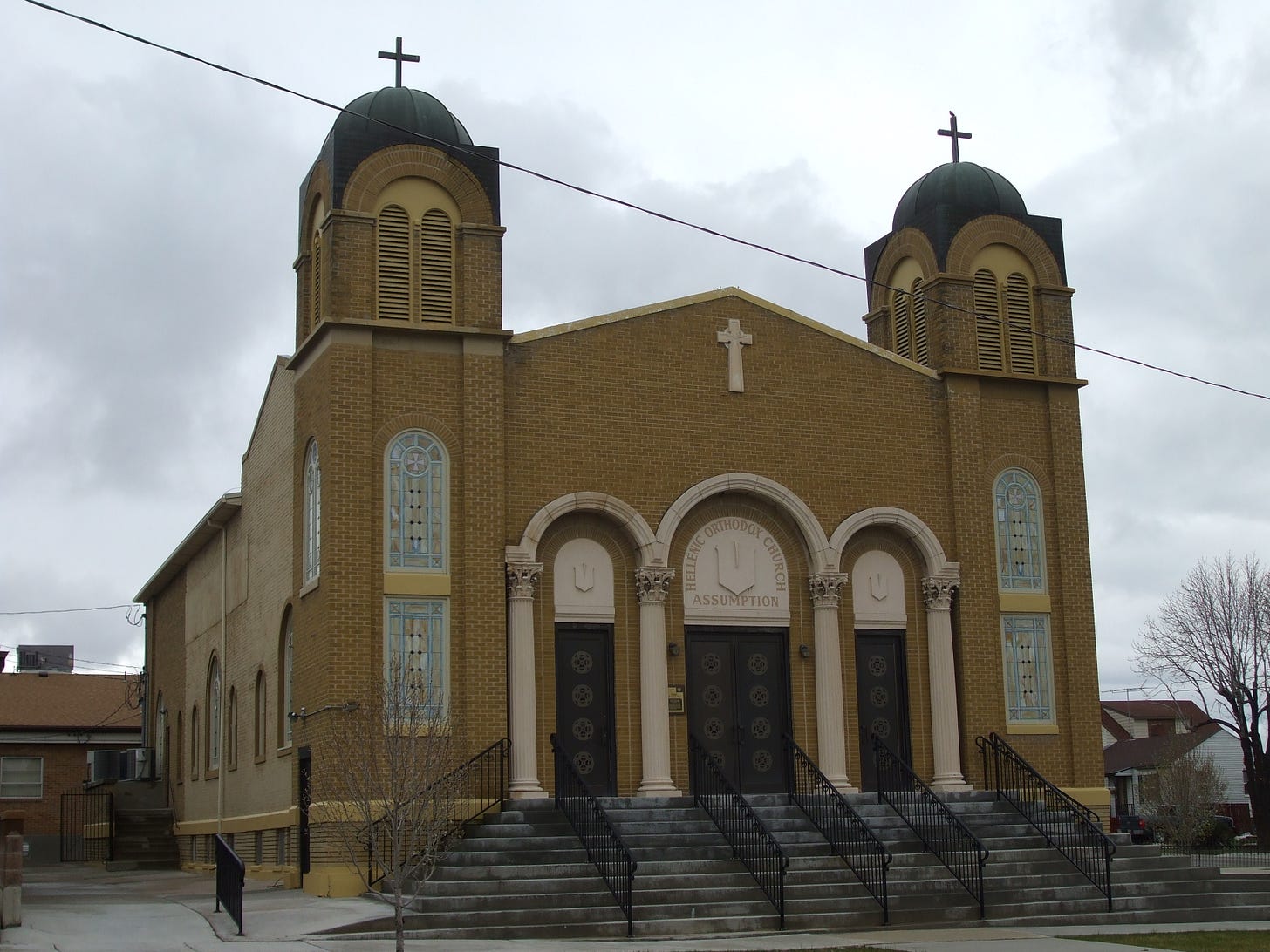
Price, Utah: The Price Sun (1/28/1916) reported on the soon-to-be-built Greek church, “The church proper will seat approximately five hundred persons.” I’m quite skeptical of this. Did Price really have a Greek church large enough to seat 500 people? Isn’t it more likely that it could hold 500 people, standing? Here’s a photo of the church building (which was enlarged in 1941). It sure doesn’t look big enough for a seating capacity of 500:
Roxbury, Massachusetts: St John the Baptist Greek Orthodox Church in Roxbury also may have had leaners; in any case, it doesn’t seem to have had pews, based on this item from the Boston Globe (8/30/1924): “For religious services the church has a seating capacity for 100 people, with additional room for 300 standing.”
On February 14, 1925, a Greek Orthodox parish priest, Archimandrite Kyrillos Papageorgiou, wrote a letter to the leadership of the fledgling Greek Archdiocese of North and South America.1 The newfangled addition of pews had created a new challenge: when should parishioners sit, and when should they stand?
14-2-1925
To the Holy and Sacred Synod of the Greek Orthodox Church in America
New York
Your Eminence, Mr. President,
It is well known to your Eminence that in many American Orthodox Churches they have put seats, instead of the stalls (stasidia) which we have in our churches in the homeland. The seats have been laid out towards the purpose that the Christians may sit during the divine services. A blessed question arises though. Do the Christians know when they should arise and when they should sit? From a first glance, my question may appear to you as being trivial and unworthy of conversation and attention. But if you think a little, you will see that it is worthy of careful thinking, because it pertains to the order and decoration of not one, but of all Orthodox Churches in America. And so that problems do not arise: one Christian from one city traveling to another and seeing a difference in the Church, not knowing himself when he should sit and when he should stand. Therefore, according to my humble opinion, the Synod should publish an encyclical epistle to all the priests in America, setting forth precisely the moments when the Christians should sit and when they should stand. The priests should teach the contents of the encyclical to the faithful.
Finishing with respect,
Your child,
Archimandrite Kyrillos Papageorgiou
I’ve found no evidence that the Greek Archdiocese leadership ever responded to Papageorgiou’s letter or published anything official on the topic, but its existence shows that, as of 1925, pews were a novel thing, something that had only recently been added to Orthodox churches.
If you’ve gotten this far — well, first of all, congratulations. That was a lot.
But you might have noticed a kind of shift that began in the 1920s. Prior to that, pews were exceedingly rare, with few documented cases. Why did they start to appear in the 1920s?
The truth is, it’s a bigger story than pews. In 1921, Congress began to impose immigration quotas — initially not too strict, and explicitly temporary, but they were renewed in 1922, and then in 1924, a new Immigration Act effectively ended the flow of immigrants into the United States. The immigrant-based Orthodox churches in the United States faced increasing pressure to assimilate into American society. Pews are just one small part of that story, one of many adjustments that some Orthodox communities made to become more American.
Finally, if you have information about other parishes and when they installed (or removed!) pews, please post a comment below.
Orthodox History is a publication of the Orthodox Studies Institute at Saint Constantine College. Our work is possible thanks to the support of generous donors. You can make a donation by clicking here.
The Papageorgiou letter was published in Paul Manolis’s multi-volume archival connection, History of the Greek Church of America in Acts and Documents, and was translated for me back in 2009 by Ioannis Fortomas, who is now a priest.
Leave a Reply