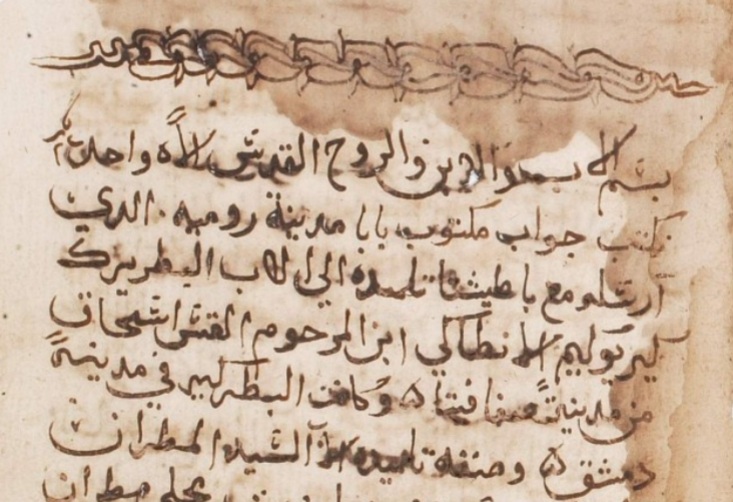
Over the course of the 16th century, as Rome lost much of northern and western Europe to the Reformation, it redoubled its efforts to win over the Christian East. At first, Rome’s attention in the Levant was directed toward the Maronites, who had formally submitted to the Papacy in the 12thth century but still retained many practices incompatible with Tridentine norms. Starting in 1578, the Jesuits Giovanni Battista Eliano and Giovanni Bruno were sent on a series of missions to the Maronites to arrange liturgical and canonical reforms in their rite, including adding recitation of the Filioque to the liturgy and an aggressive campaign of burning earlier Maronite liturgical and theological manuscripts. The two Jesuits were also under instruction to initiate contacts with the Orthodox of Syria, and, as chance would have it, the situation in the Patriarchate of Antioch provided an opening.
In the spring of 1581, the Orthodox of Damascus forced Patriarch Michael al-Hamawi to resign and leave the city, inviting the metropolitan of Tripoli, Joachim Daw, to replace him. Michael quickly recanted his resignation and so the patriarchate was divided, with the northern dioceses supporting Michael and the south supporting Joachim, anticipating the repeated splits between Aleppo and Damascus over the following century and a half.
Later that year, the papal envoys met with Joachim and a group of Orthodox notables in Damascus. They asked the patriarch to write Pope Gregory XIII a letter expressing filial love and recognizing the Pope as his “true father.” While Joachim’s response was polite, the meeting soon devolved into a debate over the filioque and other reasons for the Great Schism, but in the end he did send a friendly letter to Rome, albeit without any dogmatic content.
In 1582, the rival claimants to the patriarchate met in Tripoli for arbitration conducted by the patriarchs of Alexandria and Jerusalem. Michael would have known that the odds favored Joachim, since the latter had served as the patriarch of Constantinople’s representative to confirm the patriarch of Jerusalem in his position following a disputed election. Thus, Michael contacted Eliano, complaining of persecution from the other patriarchs and entertaining the idea of relocating to Italy. Nevertheless, after a final, futile attempt to win support in Constantinople in 1583, he gave up his claims and retired to Aleppo.
That same year, Rome sent a new mission to Syria, headed by the Maltese Leonard Abel, who had been made titular bishop of Sidon, with the express purpose of winning over the Greek and Syriac Orthodox. In the spring of 1584, he met with Joachim Daw in Damascus, presenting him with a letter from Gregory XIII inviting him to accept the Council of Florence and adopt the Gregorian Calendar. The patriarch responded that he knew nothing of such a council and needed to consult with the other patriarchs about it. While it is highly improbable that he was unaware of the Council of Florence, it is very likely that Antioch was never formally notified of its decisions, since both of the patriarchate’s two nominal representatives at its conclusion—Isidore of Kyiv and St Mark of Ephesus— who had never directly communicated with Antioch, were quickly embroiled on opposite sides of the struggle over the council elsewhere.[1] Abel was evidently prepared for such a response and left the patriarch with a copy of the council’s acts.
Soon after this, Joachim, who had brought the patriarchate to the point of bankruptcy during his dispute with Michael, left for Constantinople and thence to Moscow to seek funds. In Eastern Europe, he gained first-hand experience of the results of Rome’s drive to subjugate the Orthodox Church there and he personally approved the statutes of the Lviv Dormition Brotherhood, established to resist aggressive Polish Catholic proselytism. During Joachim’s absence, Abel met with the former patriarch Michael and succeeded in having him sign a Roman Catholic confession of faith, which he sent to Rome along with a request for support. None was forthcoming. Rome was certainly aware of the hopelessness of Michael’s position and, having obtained his signature, unceremoniously ceased all communication with him.
At some point after Joachim returned to Damascus from Moscow in 1587 with his finances in order, he entrusted his protégé Anastasius ibn Mujalla to write a response to Pope Gregory XIII rejecting both the Gregorian calendar and union with Rome. Anastasius, who became metropolitan of Tripoli in 1590, seems to have been the most powerful figure in the patriarchate during Joachim’s old age, exercising a role supervising the coastal dioceses of Beirut, Tyre and Sidon as well as the Monastery of Saidnaya.
Anastasius begins his Response with a very irenic restating of the contents of the missionaries’ message, but over the course of the text his tone gradually shifts to a categorical rejection of the Pope and the Roman Church. This initial exaggerated politeness is characteristic of how Orthodox churchmen in Syria treated the missionaries until pressed to do otherwise, and this habit has often been misinterpreted, both in the missionaries’ reports back to Rome and by some modern historians, as signaling a greater degree of sympathy than actually existed.
Constantin Panchenko has observed that Anastasius’ calligraphic Greek signature on an Arabic document regarding Saidnaya, held in Russia, demonstrates that he was literate in Greek and speculates that he may have used Byzantine sources when composing his response. In particular, Panchenko notes the similarity of some statements in the Response to one of the earliest Antiochian reactions to the Latins, Logos 38 of the Taktikon written by Nikon of the Black Mountain, supervisor of the monasteries around Antioch at the turn of 11th-12th centuries. It is worth noting, however, that Nikon’s Taktikon was translated into Arabic in the 12th or early 13th century and circulated during the Ottoman period, both as an integral text (for example, here) or with the section on the errors of the Latins as an independent treatise (see here, starting at f. 46r). Moreover, Anastasius’ selection of Old Testament proof-texts for the Trinity seems to be derived from Arabic apologetic works written with Islam in mind, particularly the writings of Theodore Abu Qurrah.
While Anastasius’ arguments against azymes and the Filioque offer little that is new, the metropolitan did find himself in the new position, perhaps for the first time in the Ottoman era, of having to define the religious identity of his community, which he calls “the Melkite Rum.” In keeping with Antioch’s renewed contact with the wider Orthodox world in this period, Anastasius sees his church as belonging to a globe-spanning communion made up of “Rum, Russians, Georgians, Wallachians, Serbs, Moldavians, Turks [i.e., the Turkish-speaking Orthodox of Anatolia], Arabs and others in various places,” who, “despite the remoteness of their countries from each other and the differences in their language” are united in dogma, ritual and practice. He nevertheless remains somewhat within a medieval framework and is very concerned to draw a distinction between the “Melkite Rum” and the other, heretical sects in the region which are named after their founders (i.e., “Jacobites”, “Nestorians”, “Maronites”, etc.). In doing so, he makes use of an anonymous Arabic treatise, dating to no later than the beginning of the 15th century, which interprets “Melkite” to refer to “God, the King of Heaven” rather than any earthly king.
Even more important for him, however, is his church’s apostolic foundation. While he considers Peter to be the leader of the Apostles, the fact that Peter preached in Antioch and Syria and that his teachings there were confirmed by the fathers and Ecumenical Councils means that the Church of Antioch holds the original, apostolic faith and practice and that Rome cannot claim apostolic or Petrine support for its innovations. Implicit here is the sharp contrast between Orthodox and Counterreformation understandings of apostolicity: for Anastasius, it means the unchanging transmission of the original Christian preaching and practice, confirmed and articulated by the fathers and councils, while his opponents understand it to be a succession of personal authority to make changes in the Church.
Anastasius’ text circulated widely down at least until the beginning of the 18th century and nine surviving manuscript copies are known to exist. This enduring popularity seems to have been a cause of vexation for the Latin missionaries. In the mid-17th century, the Roman Congregation de Propaganda Fide asked François Piquet, the French consul in Aleppo, to find the text and he responded that he was able to secure several copies and remove them from circulation. A refutation was also written in Arabic by the Capuchin missionary Bonaventure de Lude (d. 1645), manuscripts of which can be found here, here and here. It is of interest largely for the bewilderment it expresses regarding Anastasius’ use of Christian Arabic Trinitarian apologetic—another excellent illustration of the incompatibility between the Patriarchate of Antioch’s theological tradition and the Counterreformation way of thinking promoted by the missionaries.
Although Panchenko wrote two brief studies in English dealing with Anastasius and his times (available here and here) which serve as the source of the historical outline above, the Response has not yet been edited or published. Presented below is a preliminary translation, based on a deliberately eclectic comparison of manuscripts Balamand 123 (copied in 1660) and Beirut, Bibliothèque Orientale 617 (copied in 1698), which was made by a pro-Latin copyist to serve as context for de Lude’s refutation. It can be hoped that in the future this important work will receive more detailed philological and historical attention leading to a proper critical edition.
In the Name of the Father, the Son and the Holy Spirit, One God.
We copy the response to the letter of the Pope of the city of Rome which he sent with his disciple Battista to our father Patriarch Joachim of Antioch, son of the late priest Isaac from the city of Safita, when the patriarchate was [already] in Damascus. It was composed by his disciple, our master Metropolitan Kyr Anastasius from Marmarita, from the Mujalla family, metropolitan of Tripoli, Beirut, Tyre, Sidon and their dependencies. May the Lord God have overflowing mercy on their souls and let them inherit His heavenly kingdom and may He give us a portion and share in His heavenly kingdom with them.
The response is written as follows: [2]
[To] the one we know as the Pope and leader of the great city of Rome and all the countries of the Franks:
Your letters have reached our country and we read them and understood their content and what you have mentioned about the cause of these schisms and the separation that was sown by our enemy the devil (may God humiliate him) among His Christian servants for so many years. You also mention in your comments that our fathers, hierarchs, patriarchs, metropolitans, bishops, abbots and monks, and in general the race of the Melkite Rum [jins al-rūm al-malakiyya] should be completely united with our father the Pope of the city of Rome in one creed and one church as our fathers the earlier patriarchs were united with the most holy popes, the 318 divine fathers of the First Ecumenical Council of Nicaea, and the Second and Third Councils down to the Seventh, until a short time after it.
His emissaries have also mentioned about our father the Pope that he is not like the previous popes before him because he possesses knowledge, discernment, vigilance, honor, sincere religion and true love; he also has exceeding zeal and has made enormous effort to build monasteries, educate monks, renovate and decorate churches and set aright their disorder; that his greatest concern is for the poor and destitute, educating orphans and visiting widows; that he makes very great effort to build hospitals and schools [buyūt al-ʿilm]; that he is also concerned with gathering together knowledgeable and scholarly people from all the denominations [ṭawāʾif] who are educated and skilled in all the sciences, to pay them stipends and arrange salaries for them by which he may obtain the great reward with all those who seek knowledge and love teaching; and that his greatest effort and ultimate desire is to bring together all Christians from the four corners of the inhabited world through his emissaries and letters in one assembly [majmaʿ] so that there may be unity of all us Christians who submit to and obey the law of God and that we may all be completely united in spiritual love, all of us with one confession free of falsehood and corruption, declaring one creed and one belief and proclaiming one, holy, universal and apostolic Church and one baptism, which was proclaimed by the holy Apostles, the divine fathers and those who followed in their footsteps.
When we heard that, we rejoiced exceedingly with spiritual gladness, our community and the entire Orthodox Christian people. We asked God the Father Almighty and our Lord Jesus Christ, the support of the Holy Spirit and the holy Apostles that our father the Pope’s will and everything he planned be accomplished in the way of truth that pleases our Lord Jesus Christ and not in a way that angers Him; that He may bring us together so that we may become one flock of the one Shepherd who is our Lord Jesus Christ, by the intercession of those who pleased Him by their good deeds, amen.
Our father also wrote to us and mentioned in his remarks that there gathered with you in the city of Rome from all denominations scholars and people educated in the celestial movements, observation and astronomy, who know the movements of the heavenly bodies, the path of the sun and the phases of the moon, studying the gradation of time, equinoxes and variations, and that they made an enormous effort over almost twenty years from the time of the previous Pope, as you have mentioned, to our own time, until they achieved their goal. That is, they subtracted the time since the era of the 318 [fathers of the Council of Nicaea], after having examined it thoroughly, calculated it precisely and subtracted from it years, months, days, hours and seconds. When they achieved this, they saw that time was lacking ten days and a little bit more, but close to ten days. When they saw that, they decreed that the feasts be moved to their places according to the missing ten days. This is according to the equinox and variations, lest corruption occur in the world and the feasts continue to be celebrated on the wrong date. This is because the 318 [fathers] were ignorant of this matter, since Pascha and the other feasts were celebrated on the wrong date for many years in the past because the equinox was on the wrong date.
When they saw this after establishing that ten days’ time was lacking, and this lack is from October, you decreed that all the fixed feasts should be celebrated with the removal of ten days, so that the fifth day of October becomes October fifteenth, the sixth the sixteenth and so too the rest of the months. You have seen to this matter, written it down and affirmed it, by order of our master the Pope in the presence of hierarchs, archons, notables, and the leaders of the community of the Romans and in the presence of a large group from every country of the Franks.
You have also mentioned in your comments that you have written letters and sent emissaries to all the nations, peoples, tribes and languages and to kings, sultans, governors, nobles, leaders, lords, patriarchs, metropolitans, bishops, oikonomoi, abbots of monasteries and monks of all the Christians near to you and far away in the four corners of the inhabited world, and also to our leaders, so that we might arrange this matter, endorse it, write it down, affirm it and emulate what is in it.
Our father and all the scholars you have mentioned, present and absent, near to you and far away, are aware that this matter you have mentioned is extremely difficult for all who hear it. How could it not be, when it is not hidden from our father’s knowledge that when the Holy Spirit rested upon the holy Apostles, the disciples of our Lord Jesus Christ, in the Upper Room of Sion, before they went out into the world, proclaiming the Gospel, they established for Christians a law, decrees, traditions [sharīʿa wa-aḥkām wa-sunan] and canons, arranged them, wrote them down, confirmed them and promised blessings and good things to those who keep them and anathemas and eternal torment in the afterlife to those who transgress them. Afterwards, the 318 pure fathers followed in the footsteps of the Apostles and built upon their foundation, as did the Second and Third down to the Seventh council. All of them anathematized, condemned and excommunicated anyone who contradicts the holy Apostles. They decreed in their divine canons composed by the Holy Spirit and said: let anyone who transgresses what we have defined and confirmed be anathema, cut off from the glory of God the Father and the grace of the Holy Spirit.
All of us know that the holy Apostles and divine fathers, from the First Ecumenical Council down to the Seventh Council did not do anything of their own and did not speak on their own behalf. Rather, everything they did was by the inspiration of the Holy Spirit. Therefore, all of us, our hierarchs, kings and all our people scattered in the four corners of the world, such as the Rum, Russians, Georgians, Wallachians, Serbs, Moldavians, Turks, Arabs and others in various places, despite the remoteness of their countries from each other and the differences in their language, all of them, from the time of the Holy Apostles and the divine fathers of the seven holy Ecumenical Councils until today confess one creed, one dogma, one Church, one baptism, one rite [ṭaqs]. Our feast is one. Our prayer is one. Our calendar [mawsimunā] is one. All of us have one affair, and nevertheless, we have not received this dogma and these traditions, such as the fast, prayer, seasons, feasts that you have from unknown persons like the rest of the sects outside [the Church]. If they have two churches in one country, they make in each church a rite and a prayer different from the other church, like Arius and his party, Eutychius, Origen, Nestorius, Dioscorus, Jacob Baradaeus, Maron[3] and other heretics who blaspheme against the Holy Spirit. Indeed, we received them from the holy Apostles and the 318 divine fathers whose signs were dazzling and whose wonders were manifest.
So how can we change traditions like the most holy ones that have been mentioned, and hold to the words of unknown people who have no achievement other than observation, astronomy and knowledge of the spheres? All of these things are outside our tradition and far removed from our religion [sharīʿatinā].
If you say that the 318 fathers who handed these traditions down to us [sannū la-nā hādihi al-sunan] and arranged for us this order, and after them Basil, Gregory and John Chrysostom were ignorant of this matter in their time and did not understand it, you should be told that if such paragons of holiness, learning and knowledge were ignorant, as you have said, then how much more ignorant are your scholars whom you have mentioned in our time!
So we say to you that no, they were not ignorant, but rather when the holy Apostles and divine fathers looked at time and its gradation, [they saw that it is] like the sea and its undulation. Whether the sea and its waves increase or decrease, they do not depart from its limit, but rather its waves are held within it. So too with time, whether its days increase or decrease, their increase and decrease is from it and in it. For when the fathers examined the year, [they saw] four natures, that is, four seasons—summer, spring, fall and winter—each season fixed in its place, unchanging, like the time in which God arranged them. Likewise, the holy Apostles and divine fathers arranged the fasts and feasts in their places and saw that, even if the days of time increase and decrease, they do not change. If that is the case, then what necessity requires us to change what the holy fathers have arranged and move the feasts that were arranged and fixed upon the foundation of the holy Apostles, to other places? In doing so, we would incur great corruption and much distress in our religion [sharīʿatinā] and among the people of our religion [ahl millatinā], and we and the feasts would, by God, remain under the decisive anathemas and the prohibitive condemnations.
Nevertheless, when the holy Apostles and divine fathers learned through the Holy Spirit that in matters such as this corruption occurs in the world and ignorant people would depart from us, dividing the flock, rending dogma, and disturbing the Church, and that they would change the feasts, [the Apostles and fathers] made for us an upright technique [uslūb] in the Great Triodion. That is, the cycle from the era of our father Adam until our own day. Every 532 years, the sun returns to its place, the moon to its station, the equinox to its place, the feasts to their places, and the seasons, years, months and days, each one [again] like the time, day and hour when it was arranged.[4] This has been written and confirmed with us from the time of the 318 [fathers] until today, so how can we abandon what we received like this from the holy fathers who speak by the Holy Spirit and hold to the words of ignorant astrologers, as you have mentioned? You know that this matter you have mentioned is never, ever fitting for any rational person who hears it and only the ignorant and those lacking intellect and knowledge will pay it heed.
Our father also wrote in his letters inviting us to accept an eighth council. We have not at all heard of this council and we have no original copy of it. We have not received news of it either in our books or in our country and not even our patriarchs who previously reposed, even though you state that there gathered at it 140 hierarchs known for their holiness, and that the Patriarch of Antioch, the Patriarch of Jerusalem, the Patriarch of Egypt and the representative of the Patriarch of Constantinople were present[5] along with the Pope at that time; and that they anathematized anyone who does not believe that the Holy Spirit proceeds from the Father and from the Son and anyone who does not offer unleavened bread at the liturgy, rejecting leaven.
We inform His Holiness our father the Pope and all the scholars he has that this heresy [bidʿa] is more wicked[6] than all the heresies that occurred before them because it is extremely wicked and more powerful unbelief [aqwā kufran] than the heresy of Arius, Eutychius, Nestorius, Dioscorus and Jacob Baradaeus, who tore the Son from the essence of the Father, believed that the Spirit was created, and imposed crucifixion on the Godhead by saying “Holy God, Holy Mighty, Holy Immortal who was crucified for us.”
Just as they imposed crucifixion on the Godhead, made the Holy Spirit created and tore the Son from His Father’s substance, so too did the participants at this council and the Pope who presided over them believe that the Holy Spirit proceeds from the Father and the Son, contradicting what was pronounced by the holy Apostles and divine fathers who proclaimed that the Holy Spirit proceeds from the Father and is with the Father and the Son, since the divine fathers of the Council of Nicaea declared that the Father is begetter, the Son is begotten and the Holy Spirit is procession, that is, that the Holy Spirit proceeds from the Father and rests in the Son and is not separated from the Father. The Three are one God, one authority and one divinity [rubūbiyya], without confusion or separation. You, however, say “proceeds from both,” and make the two separate. If the Holy Spirit, who is the Spirit of the one pre-eternal [qadīm azalī] God, proceeds from the Father and from the Son, as you claim, then where does He rest? He would necessarily rest in another. According to this opinion of yours, the Trinity would become a quaternity. This revolting syllogism resembles the claims of the Nestorians, since they abandoned the Trinity and worshiped a quaternity by saying that Christ has two hypostases. You have affirmed something even more contemptible by saying that He proceeds from both, since it requires that He rest in another one apart from Them.
The holy Apostles and divine fathers set forth in their canons and affirmed that the Word of God is perfect God and perfect man and they declared with a loud voice and said, “and in the Holy Spirit, the Lord, the Giver of Life, who proceeds from the Father, who with the Father and Son is worshiped and glorified,” while you say, “no, rather from both.” If the holy Apostles, the 318 divine fathers and those who followed in their footsteps established in their canons and affirmed that the Holy Spirit proceeds from the Father and is with the Father and the Son, then from where can you claim something against this and contrary to what was proclaimed by the holy Apostles and divine fathers who spoke by the Holy Spirit, who manifested signs, worked wonders, spoke in tongues and said, “who proceeds from the Father and is with the Father and the Son”?
You claim the opposite of that and say, “proceeds from the Father and from the Son.” This is because the Son and creative Word of God, who remains with Him always without confusion or separation, took for Himself a body from our nature and was united to it and the Son of God the Creator became a created son of man according to humanity and does not separate from the nature of His Father the Creator. But your leaders and the fathers of this council of yours in whose footsteps you have followed teach you that the Holy Spirit proceeds from both and you make the Holy Spirit proceed from a created Son and a creating Father. This syllogism of yours requires that the two are separate, one creating and the other created and the Holy Spirit rests in another one different from Them.
If you say, “No, our leaders did not tell us such a thing. Rather, they proclaimed that the Holy Spirit proceeds from God the Father and from His Son who is His creative Word,” we will also tell you that this error is more serious, more dangerous and stupider than what preceded, because by this revolting syllogism you have separated the Father from His Son and put two gods in heaven by saying that the procession is from both. Who could hear this and not laugh at the one saying it and believing it?
The books of the Old and New Testaments bear witness along with the holy Apostles that the Holy Spirit proceeds from the Father and is with the Father and the Son because the Father is cause, the Son is caused and the Holy Spirit is procession. That is, the attributes of the spring flowing out from its source and reaching the place that God ordained for it to be in and it does not separate from its source.[7] Likewise, the Holy Spirit proceeds from the Father and is united in the Son. He does not separate from the Father and the Three are one God, as we have mentioned. Thus said the Righteous Job: “God, His Word and His Spirit created me” [cf. Job 33:4].[8] He did not say, “the Spirit of the Word,” but the Spirit of God who rests in the Word and does not separate from the Father. Our Lord said in His holy Gospel, “I drive out demons by the Spirit of God” [cf. Matthew 12:28] and did not say, “by My Spirit,” but by the Spirit of God who rests in Him. The Prophet David said, “By the Word of the Lord the heavens were established and all their hosts by the Spirit of His mouth” [cf. Psalm 33:6].[9] He did not say, “by the Spirit of the Word,” but “by the Spirit of His mouth.” That is, by the Spirit of the Father who rests in the Word and does not separate from the Father, while you say that He proceeds from both.
They were not content with that, but they even required that unleavened bread be offered in their liturgy and that leavened bread be rejected. They claim for themselves a newly-created tradition contrary to the tradition proclaimed by the holy Apostles and the divine fathers. This heresy is more repugnant, uglier and more evil than all the heresies that preceded it, because the holy Apostles and divine fathers wrote in their canons, prescribed and authoritatively stated that bread, wine and water should be offered in this mystery, which is a type [rasm] and cause of the salvation of all who believe in it. For the word “bread” [khubz] is an expression meaning “perfect” and the word “unleavened bread” [faṭīr ][10] means “deficient.” Just as the body of our Lord Jesus Christ is of the utmost perfection, so too is leavened bread of the utmost perfection.
If you say: No, unleavened, because the body of our Lord Christ is unleavened on account of the fact that sin did not enter it nor did corruption mix with it. As for bread, by the introduction of leaven into it, it becomes corrupt and God forbid that the body of our Lord Jesus Christ be corrupt! For unleavened bread is like the body of our father Adam when God created it in paradise. It was unleavened and when sin entered into it, it became leavened.
We will also tell you: The body of our Lord before the Passion was unleavened, but when the suffering, spitting, beating and crucifixion happened to it, it became leavened. That is, a perfect body. If suffering, beating and crucifixion had not happened to it, then people would think that it was a phantasm and a ghost and not a perfect body, just as unleavened bread is lacking and imperfect. When the divine fathers and their successors looked at the suffering, crucifixion and killing that affected His holy body, they made it perfect leavened bread.
Moreover, we have several testimonies from the divine scriptures that the bread is leavened. This is when He says in the pure, holy Gospel, “I am the bread [khubz] that comes down from heaven” [cf. John 6:51]. He did not say, “I am the unleavened bread [faṭīr] that comes down from heaven.” And when He says, “I am the bread [khubz] of life” [John 6:35], He did not say, “I am the unleavened bread [faṭīr] of life.” And when the devil says to Him, “If you are the Son of God, then tell these stones to become bread” [Matthew 4:3], he did not say, “become unleavened bread.” And when He tells the devil, “Depart from Me, O accursed and wretched one, it is not by bread alone that man shall live,” [cf. Matthew 4:4], He did not say, “by unleavened bread shall man live.” And when He said to His disciples in the desert, when the crowds had gathered around Him, “How much bread do you have?” [cf. Mark 6:38], He did not say, “How many loaves of unleavened bread do you have?” And when the Disciples told Him, “We have five loaves of bread and two fish,” [cf. Mark 6:38], they did not say, “five loaves of unleavened bread.” And when the Gospel says, “He took five loaves of bread and blessed and broke,” [cf. Mark 6:41], it did not say, “He took the unleavened bread.”
Before that, when the priest of the Most High God Melchisedek was serving as a priest over the body of our father Adam in the City of Peace [i.e., Salem], which is Jerusalem, with what was he serving? Was it not the bread [khubz], wine and water that he made as his offering? As the Prophet David said, “You are the priest forever, according to the order of Melchisedek” [cf. Psalm 110:4 and Hebrews 7:17]. It is known to people that Melchisedek offered bread [khubz] and wine [cf. Genesis 14:18]. What do you say? Was it unleavened? If it was, as in these testimonies, perfect, leavened bread, then from where do you call for unleavened bread, when the meaning of unleavened is “imperfect”? [And from where] do you make the body of our Lord Jesus Christ imperfect, as you claim?
If you say that when our Lord Jesus Christ offered His Mystical Supper in the Upper Room of Sion, and ate the Passover with His disciples it was unleavened bread because bread was not available at that time, since the Jews had entered into the Feast [of Passover], then you should be told: How could this be, when Pilate, his group, his officials and the nobles and judges of the city, along with all the rest of the Romans, only ate bread? Even if only unleavened bread was present in the homes of the Jews, bread was very much present in the homes of the Romans and in the market.
And if you say that the Jews were made unclean by Romans and did not eat their bread, our Lord was a Jew, and there was no leaven in the homes of the Jews on that day, then you should be told: On that night, our Lord made two suppers.[11] The first supper was unleavened. That is, it fulfilled the Law of Moses. The second supper was perfect leavened bread. That is, the beginning of the Law of the Gospel.
If you say, “Indeed not. The two suppers were unleavened,” then you should be told: Then what is the use of the second supper, if both were unleavened, as you claim? This is because our Lord Jesus Christ made two suppers in two senses, since the first supper was particular and imperfect. That is, lacking. Thus He did not call all people to accept and imitate it, because unleavened bread is lacking and imperfect. The second supper is universal, that is, perfect leavened bread, because He called upon all the nations to accept and imitate it because it is universal, general and not particular. That being the case, from where do you require it to be unleavened?
If you say that unleavened bread [fatīr] is bread [khubz], since the two phrases indicate that unleavened bread is bread, then you should be told: Unleavened is lacking and harmful to those who eat it and leaven is perfect and there is no harm in it for those who eat it because it is nutrition and life for all human bodies. Unleavened bread is very, very harmful for those who eat it because it is imperfect. So if unleavened bread is harmful for those who eat it and live off of it, how much more harmful is it for those who offer it as the body and blood of the Son of God!
If you say, “We received this rite from Peter, the Head of the Apostles, since this is what he taught when he preached salvation in Rome, Spain and other countries of the Franks,” then you should be told that Peter, the head of the company of Apostles and mouthpiece of the disciples, before he entered Rome and before he evangelized its people, preached in Antioch and Damascus [al-shām] and their countries for almost twenty years and it has not been heard that he offered unleavened bread or any of these traditions [sunan] that you have invented. If he had done any of this, this tradition would not be hidden from these countries.
Moreover, there are four patriarchs and one pope and everyone knows that the testimony of four is stronger than the testimony of one. The pure Gospel says, “By the testimony of two or three will every statement be established” [cf. Matthew 18:16 and 2 Corinthians 13:1] and it did not say, “by the testimony of one.” If the pure Gospel speaks in this way, how can we hold to the testimony of one and abandon the testimony of four?
If you say, “Our Lord said in the Gospel, ‘Beware the leaven of the Pharisees’ [Matthew 16:6], and He also said, ‘A little leaven corrupts[12] the dough’ [cf. Galatians 5:9], and for this reason we required it to be unleavened,” then you should be told that our Lord did not say it in this sense. Far be it for Him to contradict what He said on the tongues of His saints and Apostles! Rather, our Lord, knowing before this that there would appear from us outsiders who would change the traditions, invent canons, distort the scriptures and walk contrary to what the Gospel pronounced, such as Arius, Dioscorus, Nestorius and their followers, He warned us about their leaven—that is, their corrupt statements and contradictory heresies—so that they would not enter into us and leaven us, corrupting our creed and what we have received from the holy Apostles and divine fathers. For this reason, He said, “Beware the leaven of the Pharisees.”
As for the proponents of this aforementioned council, which is contrary to what the Seven Ecumenical Councils handed down, since they substituted unleavened bread for bread, made such decisions, and invented such reprehensible traditions, woe to them from God, for they have strayed and led astray with them all the sects of the Franks, causing them to err!
If you say, “Why is this council and all the Franks in error?” you should be told: This matter is proven against the sects of the Franks and their council through several proofs. It is not proven against the Melkite Rum, not even by a single proof.
First, everything we have—our rites, our creed, our dogma, our tradition, our fast, our prayer, our baptism and all the regulations ordained in our Church and our scriptures—we received from Peter, the head of the Apostles, and after him from the 318 divine fathers. We stand firm in and hold to everything they passed down, wrote, affirmed, confirmed and recorded in the registry [dīwān] of the Catholic, Apostolic Church from their time until the present day. We ask God to make us stand firm in it until our last breath.
Second, we are not named after any of the heretics [mukhālifīn] and have not followed the path of any of the blaspheming heretics. We have not held to any of the claims of the schismatics like the rest of the sects [al-ṭawāʾif], some of whom took the name of Arius, some Eutychius, others Nestorius and Jacob Baradaeus and other schismatics, because each sect of them is named after the head of their heresy [bi-raʾs bidʿatihim]. As for us, our name is the Melkite Rum. That is, followers of the Heavenly King, who is the King of Kings and Lord of Lords.
Third, we hold fast without addition or subtraction to everything that the holy Apostles, the divine fathers and their successors who followed in their footsteps at the Second, Third, Fourth down to the Seventh council handed down and everything that they wrote in their canons and confirmed, because the pure fathers of the Seventh Council, after completing everything that the Church needed, anathematized, excommunicated and condemned anyone who went back and added, took away, changed or held a council contrary to what they handed down or believed in a council other than these seven holy Ecumenical Councils that were arranged by the Holy Spirit. May [such a person] be anathematized and excommunicated from the glory of God the Father, from His eternal Word, and from the grace of the Holy Spirit. He will not have forgiveness, since the Apostle Paul, the mouth of Christ and the teacher of the Church, said, “If an angel comes to you from heaven and evangelizes to you something other than what we have evangelized to you, let him be anathematized and excommunicated” [cf. Galatians 1:8]. These are the decisive anathemas and the prohibitive condemnations.
From where do you call for accepting such a council, especially given that it is very contrary to what the Seven Councils handed down and required? But all of this is so that the words of the pure Gospel may be fulfilled, where it says, “There will certainly be scandal, but woe to the person through whom scandal comes. It is better for that person not to have been born” [cf. Matthew 18:7]. The one we understand by it is our father the Pope and all the countries of the Franks. The pope who presided at that council and instituted such heresies [bidaʿ] is the one who claims procession from the Father and from the Son, the offering of unleavened bread and the rejection of leaven. And he was not satisfied with this. He even forbade what is permitted and permitted what is forbidden [ḥarram al-ḥalāl wa-ḥallal al-ḥarām], such as carrion and strangled meat, monks’ eating meat after they had to eat vegetables and nothing else and sleep on the ground, shaving priests’ beards, preventing them from marrying, plucking their moustache, and many other repulsive things that anger God very much. All of this is for his own purpose, the whim of his wicked heart and his inclination to contrariness. He disturbed God’s Church, scattered its unity, distorted its books and changed its traditions. He split Christ’s flock, disturbed its affairs and scattered its order.
His woe from God will be long and his punishment will be terrible because he made himself like someone who was entrusted with a ship on which were the king’s children to hire a captain experienced in dealing with the sea to guide and pilot it. But instead, he took someone without experience and made him captain. When he entered a storm and the waves crashed upon him, he could not find a single means of guidance, so the ship sank, with everyone in it. When the king, the father of the children, comes, from whom will he seek the truth? It will not be from anyone else but that miserable person. He will punish him specifically with every punishment on account of his children and his ship. If an earthly king will punish someone like this who lacks discernment in this world, how much more will the Heavenly King punish a shepherd such as this, who has scattered His flock, His rational sheep, to the four corners of the inhabited world!
If you say, “This council of ours is confirmed by holy hierarchs, divine fathers, intelligent scholars who keep the Old and New Laws: for us it is like the Seven Councils,” I will tell you that we did not confirm their statements, precepts and traditions because of their words, but because of their dazzling miracles and manifest wonders. For among them were some at whose hands miracles appeared, and some who prayed asking God to manifest them at the hands of another, and some to whose minds came testimonies from the old and new scriptures confirming their words. If not for that, no one in the entire world would accept their words or affirm their statements. Perhaps what they had would be taken from them, as our Lord said in His pure Gospel to that useless servant who hid the talent, “Whoever has something will be given, and it will increase, and whoever has nothing, even what he has will be taken from him” [cf. Matthew 13:12 and 25:29].
What is the necessity for this council of yours, especially since it is very, very revolting, absurd and wicked? For among all the leaders at it, not one produced a miracle, worked a sign, or brought a true testimony confirming their words.
So from where did you believe and accept it? If you say “everything they handed down to us and decreed was by many corroborating testimonies from the books of the Old and New Testaments,” then we will tell you that it is necessary for someone who wants to convince you to accept an invalid, false [ʿāṭil bāṭil] council such as this, which is outside the ways of the Christians and far from the traditions and rites of the holy fathers, to establish for it shaky proofs and testimonies as flimsy as spiderwebs.
For we have in one of the histories that a fire-priest [i.e., a Zoroastrian] composed a book based on testimonies for accepting [worship of] fire of around twelve thousand parchment leaves, and if that accursed unbeliever could compose books and testimonies such as these for accepting [worship of] perishable, transient fire, it is not much for the proponents of this council that falls outside the way of truth and uprightness to compose a book of more and more testimonies to steal the minds of ignorant people and acquire them for themselves, so that they may carry out their whims and their own evil purpose.
All of this is to fulfill God’s words by the mouth of the prophet, “Woe to those who make evil good and good evil, bitter sweet and sweet bitter, light darkness and darkness light” [cf. Isaiah 5:20]. He also said, “Woe to those who consider themselves to have understanding and deem themselves intelligent” [cf. Isaiah 5:21], so God allowed ignorant people such as those outsiders to trust in themselves that they are wise, though they are ignorant. As the Apostle Paul said, “all the wise men of this world are foolish before God” [cf. 1 Corinthians 3:19].
What is the use of accepting a council such as this one, especially since it falls under the decisive anathemas and the prohibitive condemnations? We ask God to keep us exceedingly far from a council such as this, to affirm us abundantly in what the Seven Holy Councils decreed, and to hold us close to what the holy Apostles and divine fathers decreed and handed down, by the intercession of Our Lady the pure Virgin, to whom we hold fast, along with the intercession of those who pleased Him by their good deeds. Amen.
[1] On the final assignment of representatives for Antioch, see: Constantine N. Tsirpanlis, Mark Eugenicus and the Council of Florence: A Historical Re-Evaluation of His Personality (New York: Kentron Vizantinon Ereunon, 1979), 41, 53, 73; Joseph Gill, Personalities of the Council of Florence (Oxford, Basil Blackwell, 1964), 60, 72, 208. The fact that the emperor could twice reshuffle the list of nominal patriarchal representatives demonstrates that the whole arrangement was simply a legal fiction. Even apart from resistance to the union in Constantinople, this unseriousness would likely have doomed the council in any event.
[2] This heading is taken from the Balamand manuscript. The Beirut manuscript reads: “We begin with the help of God (may He be exalted) to write the response to the Pope of Rome’s letter which he sent with Battista calling the Melkite Rum to accept the Eighth Council that they had in Rome.” Panchenko notes that every manuscript he examined has a somewhat different heading, though they all share basic elements in common. Although the heading in all manuscripts mentions “Battista”, Panchenko argues that the Response must have been written to the letter delivered by Leonard Abel.
[3] The name “Maron” is absent in the Beirut manuscript. In the Balamand manuscript it was marked out by a reader and then later written back in again in red ink by yet another reader.
[4] This refers to the Dionysian Paschal Cycle, determined by Dionysius Exiguus (d. ca. 544, recognized as a saint by the Romanian Orthodox Church in 2008), where the date of Pascha and the phases of the moon repeat in the same sequence every 532 years.
[5] In fact, the patriarch of Constantinople attended, while the other three patriarchates were nominally represented by clergy from the Patriarchate of Constantinople.
[6] This is perhaps echoing the statement of Patriarch Peter III that the Filioque is “an evil, even the evilest of evils.”
[7] This image is taken from the end of St John of Damascus, On Heresies.
[8] Use of this verse as a proof-text for the Trinity in Arabic goes back at least to Theodore Abu Qurrah’s treatise On the Union and the Incarnation. Cf. p. 32 of the Arabic edition and p. 182 of John Lamoreaux’s translation.
[9] Cf. Abu Qurrah’s treatise On Our Salvation, p. 102 of the Arabic edition and p. 148 of Lamoreaux’s translation.
[10] In Arabic, like in Greek, the words for leavened (khubz) and unleavened (faṭīr) bread are distinct.
[11] The twofold Last Supper is found in the Synaxarion for Great and Holy Thursday, composed by Nikephoros Xanthopoulos (d. 1335). This is an important indication of Anastasius’ literacy in Greek, as the Synaxarion of the Triodion was only translated into Arabic in the early 17th century by Patriarch Euthymius II (as metropolitan of Aleppo, Meletius) Karma (d. 1635) and his brother the metropolitan of Hama Thalja (d. 1650). I would like to thank Dominika Kovačević-Younes for providing me with this information to correct the earlier version of this footnote.
[12] “Corrupts” (yufsid) here reflects the mistranslation of the Latin Vulgate which renders ζυμοῖ (‘leavens’) as corrumpit.


Leave a Reply